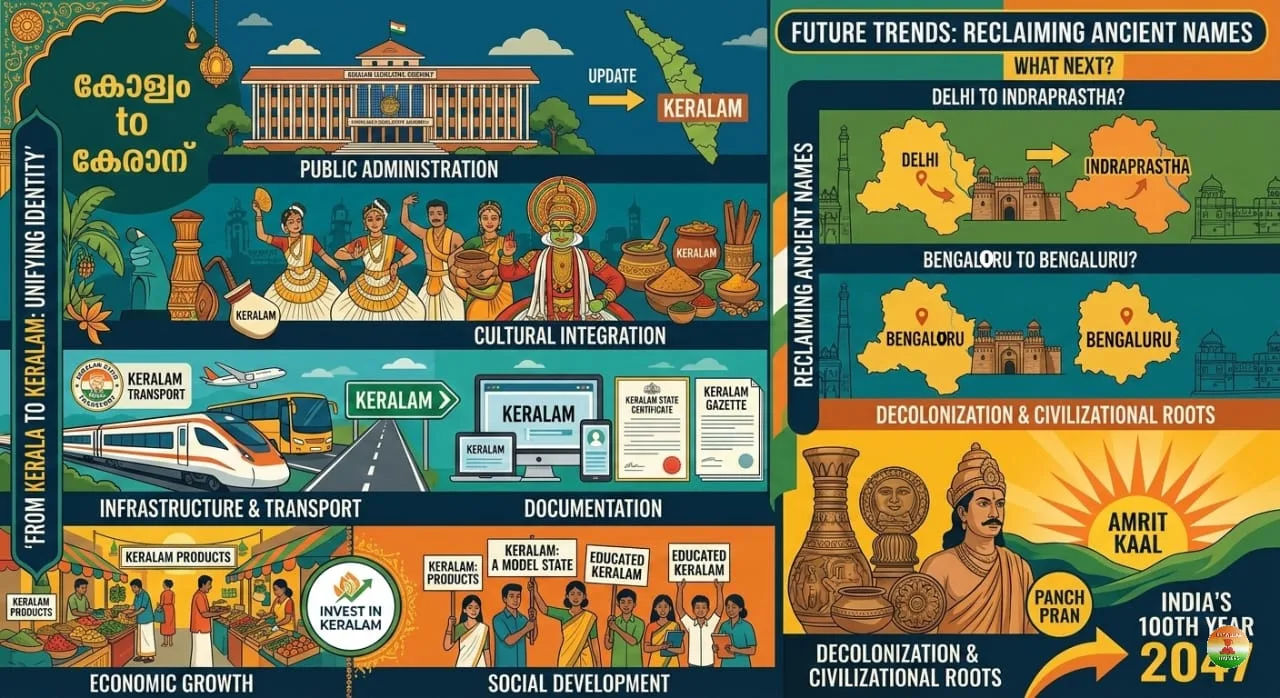
Have you recently heard the news about the southern state of Kerala changing its name? The Union Cabinet has officially approved the change from Kerala to Keralam. But why is this happening 79 years after India's independence? How will it affect your old educational certificates, property documents, and future job applications? And will other places, like Delhi, also get new names like Indraprastha?
In this comprehensive guide, we will break down the history behind the Kerala to Keralam name change, explain the legal impact on your personal documents, and explore why the Indian government is reclaiming ancient names today.
Why Was the Name Changed to Keralam? The History Explained
Changing a state's name is rarely a random decision. For the people of Kerala, this is the fulfillment of a long-standing cultural and linguistic dream.
The True Meaning of 'Keralam'
In the native language of Malayalam, the state has always been called "Keralam." The word "Kerala" is simply an English translation that became popular during British colonial rule.
The name has two main historical origins:
The Land of Coconuts: In Malayalam, "Keram" means coconut tree, and "Alam" means land. Since the state produces nearly 45% of India's coconuts, "Keralam" literally translates to "the land of coconut trees".
The Ancient Chera Dynasty: The oldest written record of the region is found in Emperor Ashoka’s Rock Edict II (257 BCE), which calls the area "Keralaputra" (son of Kerala). Historians believe "Keralam" comes from the word "Cheralam," meaning the land of the ancient Chera kings.
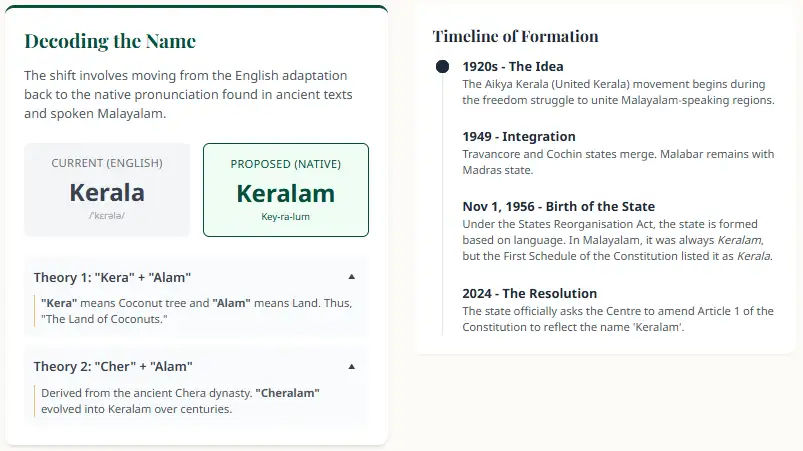
When Indian states were reorganized based on languages on November 1, 1956, the Constitution officially recorded the state as "Kerala" in English. The recent unanimous resolution passed by the Kerala Legislative Assembly simply aims to correct this to match what the locals actually call it.
How Does a State Name Change Work?
Changing the name of an Indian state is a strict process governed by Article 3 of the Indian Constitution. It is not as simple as changing a city's name.
The State Assembly passes a resolution requesting the new name.
The Union Ministry of Home Affairs and the Union Cabinet must approve it.
The President of India refers a Bill back to the state for their views.
Finally, the Parliament of India must pass the Bill with a simple majority to officially update the Constitution.
Impact on Old Certificates, Documents, and Jobs
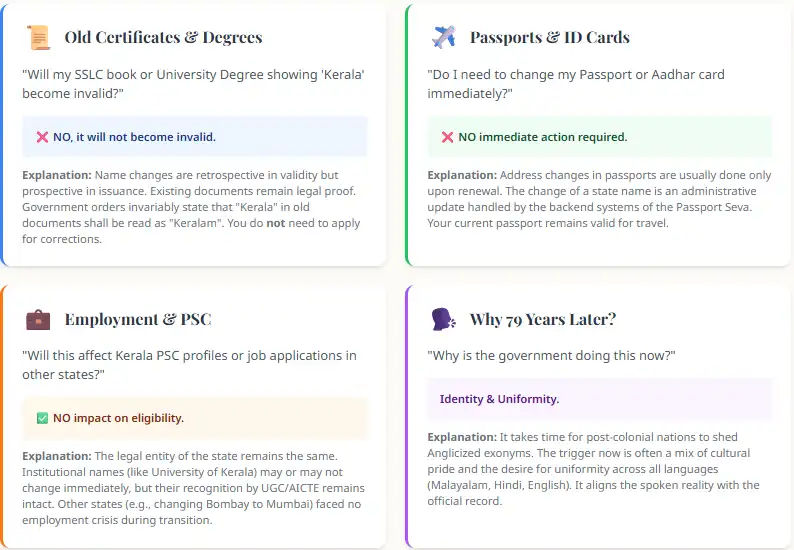
The biggest worry for common citizens during a state name change is the validity of their paperwork. Will your degree from "Kerala University" become invalid? Will you get rejected from a government job because your domicile certificate says "Kerala" instead of "Keralam"?
The short answer is: No. You do not need to worry.
The "Saving Clause" Protects Your Documents
When a person changes their own name, they have to go through a long process of making affidavits, publishing newspaper ads, and updating every single ID card (like Aadhaar and PAN) to avoid banking and job issues.
However, when a sovereign state changes its name, the government absorbs all the legal hassle. The Parliament passes the name change with a special rule called a "saving clause" or "power to construe laws."
Will Old Certificates Affect New Job Applications?
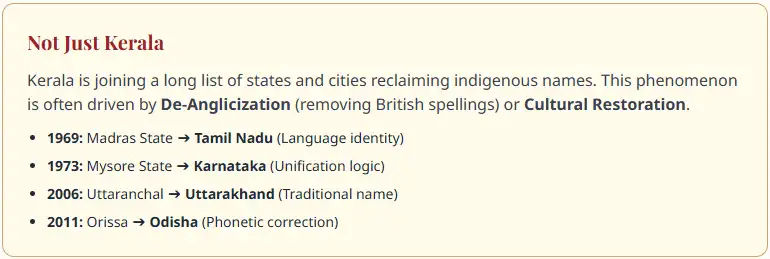
Absolutely not. Let's look at a real-world example: In 2011, the state of "Orissa" officially became "Odisha". The law explicitly stated that any old certificate, land deed, or court document that said "Orissa" would automatically be read legally as "Odisha".
Educational Certificates: Your Class 10, Class 12, and college degrees mentioning "Kerala" are permanently valid.
Job Applications: The Supreme Court and High Courts have clearly ruled that a state name change cannot disqualify a candidate from a job. Your old documents will be seamlessly accepted for both private and government jobs.
IDs and Visas: You do not need to rush to update your Aadhaar, Passport, or PAN card just because the state changed its name. Backend government systems update over time.
The Contagion Effect: Will Delhi Become Indraprastha?
The approval of "Keralam" has sparked a massive trend across India. Other states and politicians are now pushing to reclaim ancient names. The biggest demand right now is renaming India's capital, Delhi, to Indraprastha.
The Push for Indraprastha
Immediately after the Keralam decision, BJP Member of Parliament Praveen Khandelwal officially requested the Home Ministry to rename Delhi.
The Mahabharata Connection: Supporters argue that "Delhi" only represents a recent medieval history. "Indraprastha," on the other hand, was the grand capital of the Pandavas in the ancient epic, the Mahabharata.
Archaeological Proof: To back up this claim, they point to excavations at Delhi's Purana Qila (Old Fort), where archaeologists have found pottery and settlements dating back to 1000 BCE.
Everyday Use: The name is already highly recognizable. Delhi currently has the Indraprastha Apollo Hospital, Indraprastha Metro Station, and Indraprastha University. Supporters want to rename the airport and railway stations next.
Why is India Renaming Places After 79 Years of Independence?
You might wonder why the government is spending time and resources on renaming places nearly eight decades after the British left. It all comes down to a massive cultural shift known as the "Amrit Kaal" (The Era of Elixir).
Decolonization and Reclaiming Identity
Prime Minister Narendra Modi’s government has laid out a 25-year roadmap leading to 2047 (India's 100th year of independence). A core pillar of this vision is the "Panch Pran" (Five Resolves), which demands the absolute removal of any "colonial mindset" or "mentality of slavery" from the country.
This means:
Removing British Baggage: Doing away with anglicized spellings (like Kerala instead of Keralam, or Orissa instead of Odisha) to respect local languages. This also ties into the National Education Policy (NEP) 2020, which heavily promotes regional languages.
Addressing Medieval History: The current political philosophy views the centuries of rule by Islamic dynasties (like the Sultanate and Mughals) as a form of colonization as well. This is why cities like Allahabad were changed to Prayagraj, and why there is a strong push to replace "Delhi" with "Indraprastha".
Conclusion
The shift from Kerala to Keralam is much more than a spelling correction; it is a proud celebration of the Malayalam language and Indian heritage. For the everyday citizen, the law guarantees that life goes on smoothly, with zero negative impact on old certificates or job prospects. As India moves further into the "Amrit Kaal," we can expect to see more cities and states shedding their colonial or medieval names in favor of their ancient, civilisational roots.


Join our WhatsApp and Telegram Channels
Get Knowledge Gainers updates on our WhatsApp and Telegram Channels