Showing 28 books

General Knowledge
Yes & Yes General Knowledge 2025
General Knowledge is a study material published by YES & YES Publications specifically designed for competitive exams such as DSC, TET, Group II, SI, and PC. It provides a comprehensive collection of facts across various topics primarily focused on India, its states (especially Andhra Pradesh and Telangana), and international organizations.The book is structured into 124 sections, including:National and State Symbols: Details on India's national flag, emblem, anthem, song, and calendar, as well as the official symbols of Telangana and Andhra Pradesh.Awards and Honors: Information on international awards like the Nobel Prize, Ramon Magsaysay, and Booker Prize, along with national honors like the Bharat Ratna, Padma awards, and Jnanpith Award.Sports: Extensive coverage of the Olympics (Summer, Winter, and Paralympics), Commonwealth Games, Asian Games, and major tournaments in cricket, football, hockey, and chess.International Relations: Overviews of the United Nations, its specialized agencies, and various international alliances such as BRICS, NATO, and SAARC.Geography and General Science: Lists of world capitals and currencies, geographic nicknames, mountain peaks, deserts, oceans, and details about human anatomy, vitamins, and vaccines.History and Culture: Information on ancient texts, famous authors, historical battles, major structures and monuments, and traditional Indian dances.Technology and Modern World: Sections on computers, social media platforms, and ISRO's satellite launches including the Chandrayaan missions.Practice Material: The book concludes with previous years' question papers from various state-level recruitment exams.Additionally, the document mentions several ongoing and future events up to the year 2026, indicating it is an updated edition for current competitive exam preparation.
General Knowledge
9 months Current Affairs in Telugu
9 months Current Affairs, 2025 in Telugu by Vijitha Competitions
General Knowledge
2025 Sports Current Affairs
Summary: A review of major sports tournaments, winners, and medal tallies for the 2024-2025 period.Key Points:Tennis: Carlos Alcaraz won the Men's Singles at the 2025 US Open and French Open, while Jannik Sinner won at Wimbledon 2025.Cricket: Royal Challengers Bengaluru (RCB) won their first IPL title in 18 years in 2025, and India won the ICC Champions Trophy 2025.Chess: Gukesh D became the youngest World Chess Champion at age 18 in 2024.Medal Tallies: India topped the medal tables at the Commonwealth Weightlifting Championships 2025 and the Asian Shooting Championships.
General Knowledge
2025 State Scheme Current Affairs
Summary: A state-wise breakdown of welfare initiatives launched by various Indian state governments to address regional social and economic needs.Key Points:West Bengal: Launched the Shramshree Scheme to provide monthly assistance of ₹5,000 to returning migrant workers.Bihar: Introduced the Mukhyamantri Mahila Rojgar Yojana to promote self-employment by providing an initial ₹10,000 to one woman per family.Kerala: Implemented India's first project to dispose of unused medicines scientifically, named nPROUD.Madhya Pradesh & Maharashtra: Signed an MoU for the Tapti Basin Mega Recharge Project to divert water for drinking and irrigation.
General Knowledge
2024-25 Central Scheme Current Affairs
Summary: A detailed overview of active and newly launched Union Government schemes, their budgets, and primary objectives.Key Points:Education & Employment: The MERITE Scheme was approved with ₹4,200 crore to boost technical education, and the PM Viksit Bharat Rozgar Yojana aims to generate 3.5 crore jobs.Tribal Welfare: The PM-JUGA Mission (PM Janjatiya Unnat Gram Abhiyan) was approved with a massive outlay of ₹79,156 crore to benefit 5 crore tribal people.Financial Inclusion: PM Jan Dhan Yojana marked 11 years in 2025, with total beneficiaries crossing 56.16 crore.Green Energy: The PM-Surya Ghar: Muft Bijli Yojana provides up to 300 units of free electricity monthly via rooftop solar panels.
General Knowledge
2024-2025 Books and Authors Current Affairs
Summary: A comprehensive guide to the most significant books released or awarded in 2024 and 2025, prepared for competitive exam static GK.Key Points:Award Winners: Samantha Harvey won the Booker Prize 2024 for her novel Orbital.Political & Diplomatic Works: Features Why Bharat Matters by Dr. S. Jaishankar and Parliament: Powers, Functions & Privileges by K.S. Chauhan.Biographies: Includes Manoj Bajpayee: The Definitive Biography by Piyush Pandey and Droupadi Murmu: From Tribal Hinterlands to Raisina Hills by Kasturi Ray.Literary Giants: Covers The Golden Years by Ruskin Bond and Smoke and Ashes by Amitav Ghosh.
General Knowledge
All Dance Forms MCQs (SSC 2021-2022)
Summary: A compilation of 202 multiple-choice questions regarding Indian classical and folk dances that appeared in TCS-conducted SSC exams between 2021 and 2022.Key Points:Classification: Lavani is frequently used in exams as an example of a dance form that is not officially listed as a classical dance in India.Pioneers: Uday Shankar is credited with creating the "Hi-dance," which he later renamed "Creative Dance".Regional Specialties: The Jhumur dance is performed by the "Kulis" (tea garden workers) in Assam during the autumn season.Classical Exponents: Highlights famous figures like Birju Maharaj (Kathak) and the duo Radha and Raja Reddy (Kuchipudi).
General Knowledge
Census 2025 Question & Answer
Summary: A collection of practice MCQs for the SSC GD 2025 exam, specifically focusing on complex and frequently tested Census 2011 data.Key Points:Migration Trends: According to the 2011 Census, "Rural to Rural" migration represents the highest percentage of migration streams.Tribal Literacy: The literacy rate for Scheduled Tribes (ST) in India is identified as 59.00%.Administrative Authority: The Central Government holds the power to appoint the Census Commissioner for estimating ST populations under specific bills like the Goa Bill 2024.Demographic Metrics: Includes practice questions on population density (382 persons/km²) and female literacy rates.
General Knowledge
Census of India 2011
Summary: A data-heavy reference sheet summarizing the primary demographic findings of the Census of India, primarily from 2011, focusing on state and district rankings.Key Points:Population Leaders: Uttar Pradesh is the state with the highest population, while Sikkim has the lowest.Density & Literacy: Bihar has the highest population density (1,106 per sq km), and the national literacy rate is recorded at 74.04%.Sex Ratio: Kerala holds the highest sex ratio (1,084 females per 1,000 males), whereas Haryana has the lowest (877).Urban vs. Rural: The urban population in India stands at 31.1%, with the rural population at 68.9%.
General Knowledge
Census of India Concepts (Telugu Version)
Summary: A Telugu-language guide explaining complex demographic metrics and providing key data points from the 2011 Census.Key Points:Defines vital statistics such as Population Growth Rate, Birth Rate (CBR), and Infant Mortality Rate (IMR).Records 2011 core data: total population of 121 crores, literacy rate of 73%, and a sex ratio of 943.Breaks down demographic groups into categories like productive population (ages 15-60) and socio-economic classifications.
General Knowledge
Census of India (Conceptual Guide)
Summary: A foundational document explaining the constitutional framework, historical timeline, and procedural phases of the Indian census.Key Points:Traces the history of census-taking from its start in 1872 to the first synchronous census in 1881.Outlines the two major phases: Housing Census (House listing) and Population Enumeration.Explains the role of the census in demarcating constituencies and determining political representation for SC/ST communities.Notes that the census is conducted decennially by the Ministry of Home Affairs.
General Knowledge
Fairs and Festivals (SSC Static GK)
Summary: A specialized resource focusing on India’s most significant fairs (Melas) and their specific geographical venues.Key Points:Catalogs world-famous gatherings like the Kumbh Mela, Ambubachi Mela (Assam), and Sonepur Cattle Fair (Bihar).Lists essential regional fairs such as the Medaram Jatara (Telangana) and Surajkund Handicraft Mela (Haryana).Highlights state-specific cultural events like Bastar Dussehra and the Thrissur Pooram.
General Knowledge
Important Festivals in India (Telugu Version)
Summary: A regional language guide providing in-depth cultural context for major Indian festivals for Telugu-speaking students.Key Points:Offers extensive details on regional celebrations like Brahmotsavam (Andhra Pradesh) and Bathukamma (Telangana).Categorizes various New Year celebrations across the country, such as Ugadi, Gudi Padwa, and Vishu.Includes practice questions based on previous SSC exams to highlight high-yield topics.
General Knowledge
Festivals of India (Comprehensive Guide)
Summary: An annual guide that uses mnemonic "tricks" and regional grouping to help students learn India's diverse cultural and harvest festivals.Key Points:Details major harvest celebrations across India, including Onam (Kerala), Pongal (Tamil Nadu), and Baisakhi (Punjab).Features prominent tribal events like Nagaland’s Hornbill Festival, known as the "Festival of Festivals".Provides insights into seasonal fairs like the Pushkar Fair in Rajasthan and Losar in Sikkim.Explains the religious significance of events like Chhath Puja (Bihar) and Ganesh Chaturthi (Maharashtra).
General Knowledge
Folk Dances in Indian States (Reference List)
Summary: A state-wise exhaustive list of folk dances that includes both well-known and rare regional tribal dances.Key Points:Highlights unique tribal performances like the Lion & Peacock dance of Arunachal Pradesh and Karma of Jharkhand.Covers ritualistic and festive dances such as Theyyam (Kerala), Yakshagana (Karnataka), and Ghoomar (Rajasthan).Includes regional variations like Bihu (Assam) and Charkula (Uttar Pradesh).
General Knowledge
Folk Dances of India (Top 50 MCQs)
Summary: A targeted GK guide summarizing the most frequently asked questions about India's folk and classical dance forms.Key Points:Lists the eight officially recognized classical dances, including Sattriya (Assam) and Mohiniyattam (Kerala).Details essential regional folk dances like Matki (Madhya Pradesh), Rouf (Jammu & Kashmir), and Nautanki (Uttar Pradesh).Profiles famous classical exponents such as Kelucharan Mohapatra (Odissi) and Leela Samson (Bharatnatyam).
General Knowledge
Music Gharanas in India Top MCQs
Summary: A focused practice resource containing multiple-choice questions on musical gharanas designed for competitive exam preparation.Key Points:Features critical artist-dance associations, such as Birju Maharaj with the Kalka-Bindadin Gharana and Kathak dance.Provides award timelines and biographies for legendary figures like Prabha Atre and Bismillah Khan.Offers a structured overview of founders for major gharanas like Agra, Mewati, and Atrauli.
General Knowledge
Musicians & Gharanas (Vocal & Instrumental)
Summary: A comprehensive guide detailing Indian classical music lineages (Gharanas), their founders, and legendary performers across vocal and instrumental traditions.Key Points:Identifies the Gwalior Gharana as the oldest Hindustani vocal lineage, founded in the 19th century by Nathan Peerbaksh.Highlights iconic masters such as Pandit Bhimsen Joshi (Kirana Gharana) and Pandit Jasraj (Mewati Gharana), noting their prestigious awards like the Bharat Ratna.Covers instrumental maestros like Bismillah Khan (Shehnai/Banaras Gharana) and Pandit Ravi Shankar (Sitar/Banaras).Explains the historical importance of the Patiala Gharana in establishing Khayal, Thumri, and Ghazal styles.
General Knowledge
Indian Temples Top MCQ Part 1
Summary: A part-one collection of multiple-choice questions focusing on temple locations, deities, and special features.Key Points:Covers the Suryanarayana (Arasavalli) and Ranganath Swami temples.Explains unique traditions, such as the sandalwood paste ritual at the Simhachalam temple.Provides foundational GK for exams like UPSC, BPSC, and Railway on India's religious heritage
General Knowledge
Classical & Folk Dances Of India (Telugu Version)
Summary: A guide to Indian classical and folk dances, written in Telugu for regional learners.Key Points:Lists the nine official classical dances, including Bharatanatyam, Kathak, and Sattriya.Groups folk dances by state, providing a comprehensive list for competitive exam preparation in Telugu-speaking regions.Emphasizes the state origins for each dance form (e.g., Kuchipudi for Andhra Pradesh).
General Knowledge
Detailed Guide to Indian Temples
Summary: A concentrated guide on specific temples, primarily those in Andhra Pradesh and Assam, with historical construction details.Key Points:Provides in-depth info on the Venkateswara Temple (Tirumala) and Srisailam’s Mallikarjuna Temple.Notes historical builders, such as the Veerabhadra Temple at Lepakshi built by governors of the Vijayanagara Empire.Covers the Kamakhya temple in Guwahati and its spiritual significance.Lists rare features like the sandalwood-covered idol at the Varaha Lakshmi Narasimha Temple.
General Knowledge
Important Questions on Temples in India
Summary: A collection of high-yield static GK questions about Indian temples, including recent news and UNESCO nominations.Key Points:Mentions the recent UNESCO nomination of the Hoysala temples (Belur, Halebid, and Somnathapura) for 2022-23.Features details on the Ramappa Temple, which is India's 39th World Heritage Site.Focuses on key regional temples like the Meenakshi Temple (Tamil Nadu) and the Mahabodhi Temple (Bihar).Includes specific facts such as Tirupati Balaji being located on seven hills and featuring Dravidian architecture.
General Knowledge
Temples & Monuments in India
Summary: A visual and factual guide to major Indian temples, focusing on their architecture and locations.Key Points:Explains the three main architectural styles: Dravid (South), Nagar (North), and Vesar (Mixed).Covers major spiritual sites like Akshardham (New Delhi), Prem Mandir (Vrindavan), and Kedarnath (Uttarakhand).Provides historical data on temple founders, such as the Sun Temple of Konark built by King Narasimha Dev.Highlights UNESCO World Heritage sites like the Khajuraho Temple and the Kailash Temple of Ellora.
General Knowledge
Musicians & Instruments Part 2
Summary: An extension of the musician's guide with more detailed MCQs and additional legendary performers.Key Points:Highlights female pioneers like M.S. Subbulakshmi (first musician to receive Bharat Ratna) and Annapurna Devi (Surbahar).Covers classical singers like Pandit Jasraj (Mewati Gharana) and Prabha Atre (Kirana Gharana).Provides a mix of Hindustani and Carnatic music information for competitive exams like CGL and Railway.Features detailed trivia on instrument-specific maestros like Hariprasad Chaurasia (Flute) and Amjad Ali Khan (Sarod).
General Knowledge
Musicians & Instruments (Top MCQs)
Summary: A study guide focusing on famous Indian musicians, their instruments, and the awards they have received.Key Points:Profiles iconic figures such as Pandit Ravi Shankar (Sitar), Zakir Hussain (Tabla), and Bismillah Khan (Shehnai).Details major awards like the Bharat Ratna, Padma Vibhushan, and Sangeet Natak Akademi awards for key musicians.Includes information on different "Gharanas" (musical lineages), such as the Banaras and Kirana gharanas.Categorized by instrument types: Stringed (Sarangi), Percussion (Tabla, Mridangam), and Wind (Flute, Shehnai).
General Knowledge
Trick to Remember Folk Dances of India
Summary: A quick revision guide that uses mnemonic images to help students memorize over 250 folk dances of India.Key Points:Designed for rapid learning, claiming a revision time of less than 15 minutes.Uses a "question mark clue" methodology to trigger recall for various state dances.Detailed lists include dances from Jammu & Kashmir (Rauf, Hikit), Rajasthan (Ghoomar, Kalbelia), and Goa (Shigmo, Dekhni).Provides links to video tutorials for a more interactive learning experience.

General Knowledge
FATMAN BOOK
Overview and PurposeNature and Intent: Described as a "testament to the labor of love, effort, and collaboration," the book is the product of extensive discussions and the support of the "fellowship of PARMARians".Mission: Its core purpose is to transform the study of General Knowledge (GK) and General Studies (GS) into "a Journey, Not a Chore" and "a Challenge, Not a Burden". It aims to enrich the minds and strengthen the resolve of its readers, whom the author refers to as "fellow travelers".Subject CoverageThe book is a comprehensive guide covering a wide array of academic subjects, structured as follows:Geography: Covers the solar system, earth’s interior, plate tectonics, geomorphology, atmosphere, Indian geography (Himalayas, rivers, dams, monsoon, soil, agriculture), and world mapping.History: Divided into three major eras:Ancient: Stone Age, Indus Valley Civilization, Vedic Age, Jainism, Buddhism, and various dynasties (Maurya, Gupta, etc.).Medieval: Delhi Sultanate, Mughal Empire, Marathas, and religious movements.Modern: Advent of Europeans, Revolt of 1857, Indian National Congress, and the Gandhian Era.Polity: Detailed sections on the making of the Indian Constitution, Fundamental Rights, the Executive (President, PM), Parliament, and the Judiciary.ScienceBiology: Cells, tissues, kingdoms, human systems (nervous, digestive, etc.), and diseases.Physics: Laws of motion, gravitation, optics, and electricity.Chemistry: Matter, atoms, the periodic table, and chemical reactions.Economics: Basics of economy, national income, inflation, monetary policy, and five-year plans.Static GK: Covers classical and folk dances, musical instruments, census data, international/national organizations, festivals, and government schemes.Environment: Basics of environmental sciences, ecosystems, and international conventions.Key FeaturesVisual and Interactive Aids: The book uses numerous diagrams (e.g., layers of the sun, tectonic boundaries, soil horizons) to explain complex concepts.Interactive Recaps: Each major section concludes with "Parmar’s Crossword," designed to test the reader's knowledge of the preceding topics.Memory Aids: Includes "Tricks to Remember" for various lists, such as the countries the Prime Meridian passes through or the layers of earth’s discontinuity.Quick Facts: Frequent "Fact" boxes and "Gainer" sidebars provide additional high-yield information and interesting trivia.
General Knowledge
The General Knowledge of India
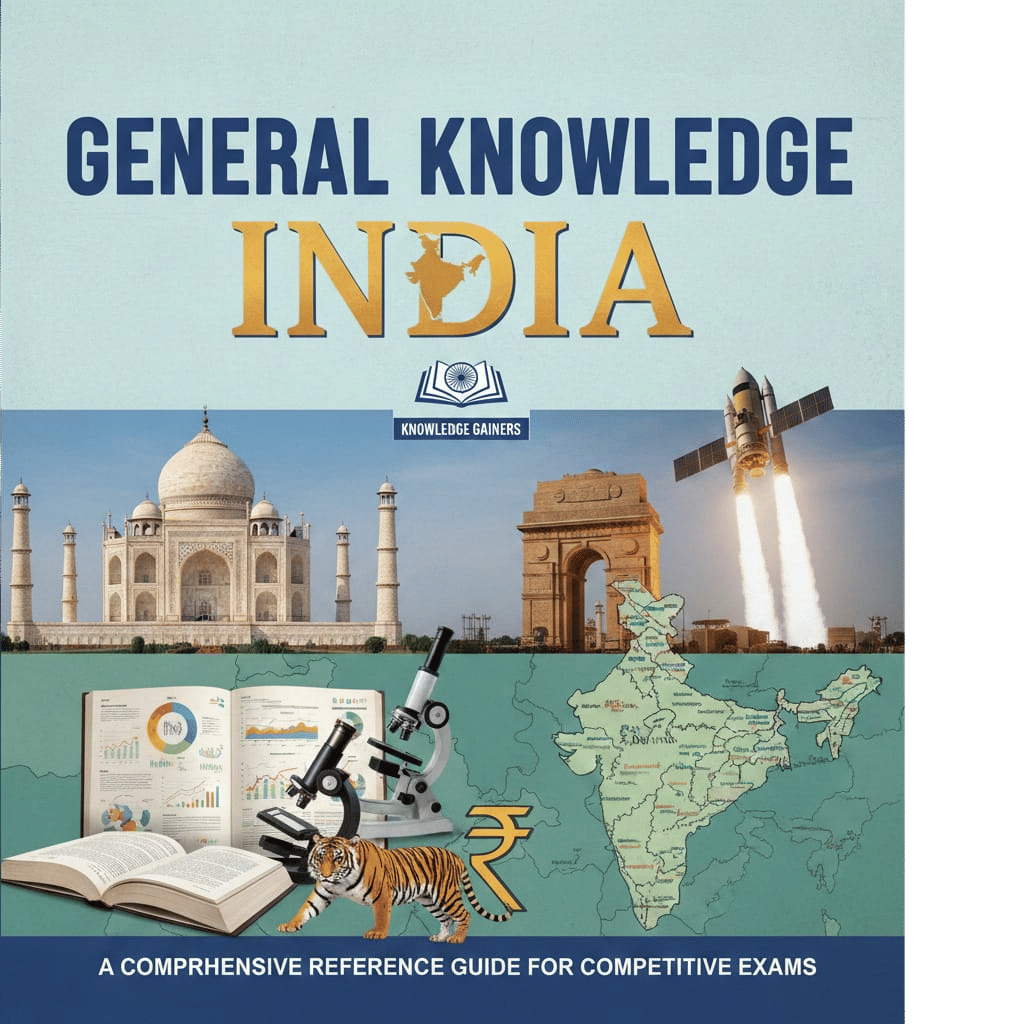
The General Knowledge India, is a comprehensive reference guide designed for competitive exam preparation, such as for the UPSC, SSC, or banking sectors. Compiled by "Knowledge Gainers," it provides a snapshot of India’s political, geographical, and institutional landscape as of late 2015.Core Subject AreasThe book is organized into 34 distinct sections covering a wide range of topics:Political Structure: Lists of Indian States and Union Territories with their capitals, Chief Ministers, and Governors. It also details the portfolios of the Union Council of Ministers under Prime Minister Narendra Modi.National Heritage and Wildlife: Extensive tables listing National Parks, Tiger Reserves, Bird Sanctuaries, and UNESCO World Heritage Sites across various states.Infrastructure and Geography: Information on major rivers and dams, railway zones, national highways, major ports, and international airports.Scientific Research: Directories of famous research institutes, including those focused on nuclear and space research like ISRO and BARC.Constitutional and Legal Data: Details on the types of writs and the twelve schedules of the Indian Constitution.Economic and Industrial Info: Tables covering major mineral resources, agricultural seasons, iron and steel plants, aluminum companies, and a list of public sector banks with their taglines and headquarters.Historical and Statistical RecordsThe book serves as a historical record of Indian leadership and achievements:Leadership Chronology: Complete lists of the Presidents, Prime Ministers, and Finance Commission Chairmen of India up to 2015.Awards: A chronological list of Bharat Ratna winners from 1954 to 2015.Superlatives: A dedicated section for "Superlatives of India," identifying the longest rivers, highest dams, largest mosques, and other notable national records.Format and UtilityStructured Tables: Almost all information is presented in easy-to-read tables, making it an efficient tool for quick fact-checking and memorization.Current Affairs Focus: At the time of its creation, it included then-incumbent officials, such as President Pranab Mukherjee and RBI Governor Raghuram Rajan.