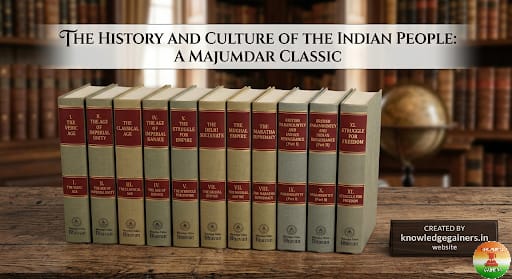
The History and Culture of the Indian People, published by Bharatiya Vidya Bhavan and edited by R.C. Majumdar, is the most comprehensive "nationalist" history of India. It was written to provide an Indian perspective on the subcontinent's journey, moving away from the Eurocentric views of colonial historians.
Here is a bird's-eye view of the entire 11-volume saga:
The Ancient Era: Foundations of Civilization
Volume | Title | Period | Key Focus |
I | The Vedic Age | Up to 600 BCE | The Indus Valley, Aryan origins, and the composition of the Vedas and Upanishads. |
II | The Age of Imperial Unity | 600 BCE – 320 CE | Rise of Magadha, Mauryan Empire (Ashoka), Buddhism, Jainism, and the Kushanas. |
III | The Classical Age | 320 – 750 CE | The Gupta "Golden Age," the Vakatakas, Harshavardhana, and the peak of Sanskrit literature. |
The Medieval Era: Transition and Synthesis
Volume | Title | Period | Key Focus |
IV | The Age of Imperial Kanauj | 750 – 1000 CE | The Tripartite Struggle (Palas, Pratiharas, Rashtrakutas) and the rise of Rajput clans. |
V | The Struggle for Empire | 1000 – 1300 CE | The Chola maritime empire, Rajput resistance, and the early Islamic invasions (Ghazni/Ghori). |
VI | The Delhi Sultanate | 1301 – 1526 CE | The five dynasties of Delhi (Khaljis to Lodis), the Vijayanagara Empire, and the Bhakti/Sufi movements. |
The Early Modern Era: Imperial Peaks and Maratha Power
Volume | Title | Period | Key Focus |
VII | The Mughal Empire | 1526 – 1707 CE | From Babur to Aurangzeb; the administrative genius of Akbar and the heights of Mughal architecture. |
VIII | The Maratha Supremacy | 1707 – 1818 CE | The rise of the Peshwas, the Maratha Confederacy, and the Third Battle of Panipat. |
The Modern Era: Colonialism and Freedom
Volume | Title | Period | Key Focus |
IX | British Paramountcy & Indian Renaissance - I | 1818 – 1858 CE | Expansion of the East India Company, social reforms (Ram Mohan Roy), and the 1857 Revolt. |
X | British Paramountcy & Indian Renaissance - II | 1858 – 1905 CE | Direct Crown rule, the birth of the Congress, and the works of Vivekananda and Dayananda. |
XI | Struggle for Freedom | 1905 – 1947 CE | From the Partition of Bengal to the Gandhian movements, the INA, and finally, Independence. |
The History and Culture of the Indian People (Full Series)
Vol | Period | Title | Key Theme | Access/Download |
I | Up to 600 BCE | The Vedic Age | Indus Valley & Vedic Foundations | |
II | 600 BCE – 320 CE | Age of Imperial Unity | Mauryan Empire & Rise of Buddhism | |
III | 320 – 750 CE | The Classical Age | Gupta Empire & Golden Age of Art | |
IV | 750 – 1000 CE | Age of Imperial Kanauj | Tripartite Struggle & Rajput Origins | |
V | 1000 – 1300 CE | Struggle for Empire | Chola Naval Power & Ghazni Raids | |
VI | 1301 – 1526 CE | The Delhi Sultanate | Khaljis, Tughlaqs & Vijayanagara | |
VII | 1526 – 1707 CE | The Mughal Empire | Akbar’s Reforms & Mughal Zenith | |
VIII | 1707 – 1818 CE | Maratha Supremacy | Rise of Peshwas & Panipat III | |
IX | 1818 – 1858 CE | British Paramountcy I | EIC Expansion & 1857 Revolt | |
X | 1858 – 1905 CE | British Paramountcy II | Indian Renaissance & Birth of Congress | |
XI | 1905 – 1947 CE | Struggle for Freedom | Gandhian Era & Independence |
Key Themes Across the Series
Cultural Continuity: Unlike many histories that see India as a series of disconnected invasions, this series emphasizes a "vital thread" of Indian culture that survives political shifts.
Nationalist Perspective: It highlights Indian achievements in science, philosophy, and governance that were often downplayed in colonial texts.
Total History: It isn't just a list of kings; it covers the evolution of art, language, law, and social customs across 5,000 years.
Join our WhatsApp and Telegram Channels
Get Knowledge Gainers updates on our WhatsApp and Telegram Channels