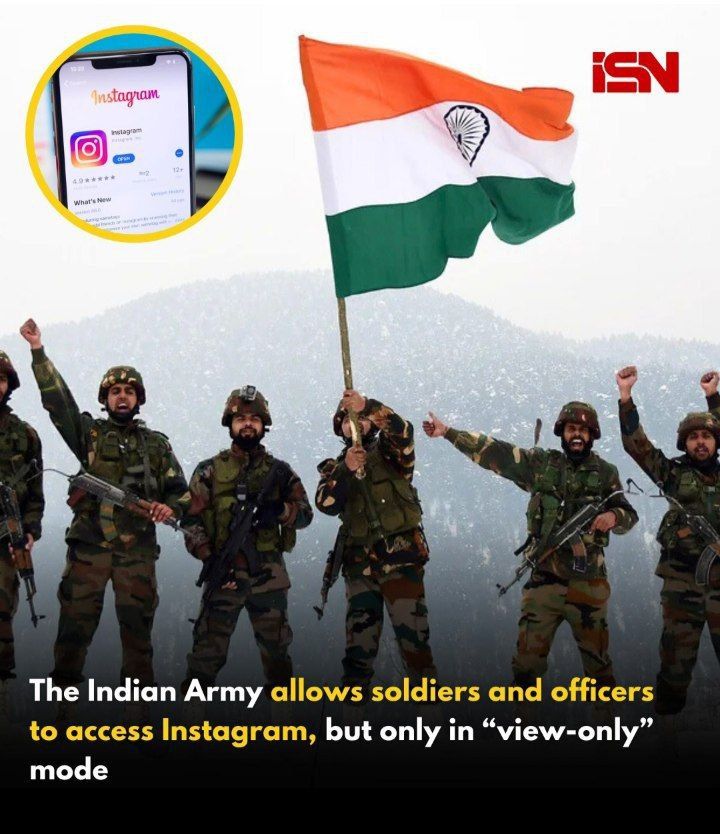
In a significant update to its digital engagement strategy, the Indian Army has officially amended its social media policy to allow personnel limited access to Instagram. Effective December 25, 2025, the new guidelines shift from previous blanket bans to a "passive participation" model, enabling over 11.5 lakh soldiers and officers to stay informed in the digital age while strictly maintaining operational security.
The hallmark of this policy is the introduction of passive consumption. For platforms like Instagram, X (formerly Twitter), and YouTube, personnel are now permitted to create accounts or sign up, but with rigorous riders.
What is Allowed?
Viewing and Monitoring: Personnel can scroll through feeds, watch reels, and monitor content solely for informational awareness and knowledge.
Information Gathering: Access is granted to help soldiers stay abreast of global developments, track emerging narratives, and identify disinformation.
LinkedIn Professional Use: Personnel can use LinkedIn exclusively for uploading resumes and obtaining information on prospective employers or employees.
What is Prohibited? (The "No-Interaction" Rule)
The Army has made it clear that any form of active engagement is strictly forbidden. Prohibited actions include:
Posting & Uploading: Soldiers cannot post videos, photos, stories, or any user-generated content.
Interacting: There is a total ban on liking, commenting, sharing, or reacting to posts.
Direct Messaging: Sending or receiving messages (DMs) on these platforms remains prohibited.
Public Debates: Expressing opinions or engaging in public discussions on public-facing networks is not allowed.
Messaging and Communication Apps
For direct communication, platforms like WhatsApp, Telegram, Signal, and Skype have slightly different rules:
Unclassified Info Only: Personnel may exchange general, non-sensitive information.
Verified Contacts: Communication must be restricted to known persons only.
Individual Onus: The responsibility for correctly identifying recipients rests entirely with the individual user.
Why This Shift? Balancing Necessity and Security
The directive, issued through the Directorate General of Military Intelligence (DGMI), reflects a pragmatic evolution in military discipline.
Smartphone Necessity: Army Chief General Upendra Dwivedi recently emphasized that smartphones are a necessity for modern soldiers to stay in touch with family and access digital reading materials.
Countering Hybrid Warfare: Controlled access allows personnel to identify potential propaganda and "hybrid warfare" tactics used by adversaries.
Preventing Honey Traps: By banning interaction, the Army seeks to prevent personnel from falling into "honey traps"—fake profiles used by foreign agencies to extract sensitive data.
Protecting OPSEC: Even a harmless "like" or comment can leave a digital trail or reveal institutional details that adversaries could exploit.
Ongoing Restrictions and Security Warnings
Despite these relaxations, the Army continues to warn against high-risk digital behaviors:
Banned Tools: The use of VPNs, torrent websites, cracked software, and anonymous web proxies is strictly prohibited.
Prohibited Platforms: Applications with significant data-breach risks or links to adversarial nations (like Facebook and TikTok) remain under a blanket ban.
Cloud Storage: Personnel are cautioned to use cloud-based data storage services only with "extreme care".
Conclusion: The 2025 social media update marks a move toward "security over convenience". By allowing passive observation, the Indian Army aims to create a digitally literate force that is connected to the world but immune to its vulnerabilities.
Join our WhatsApp and Telegram Channels
Get Knowledge Gainers updates on our WhatsApp and Telegram Channels