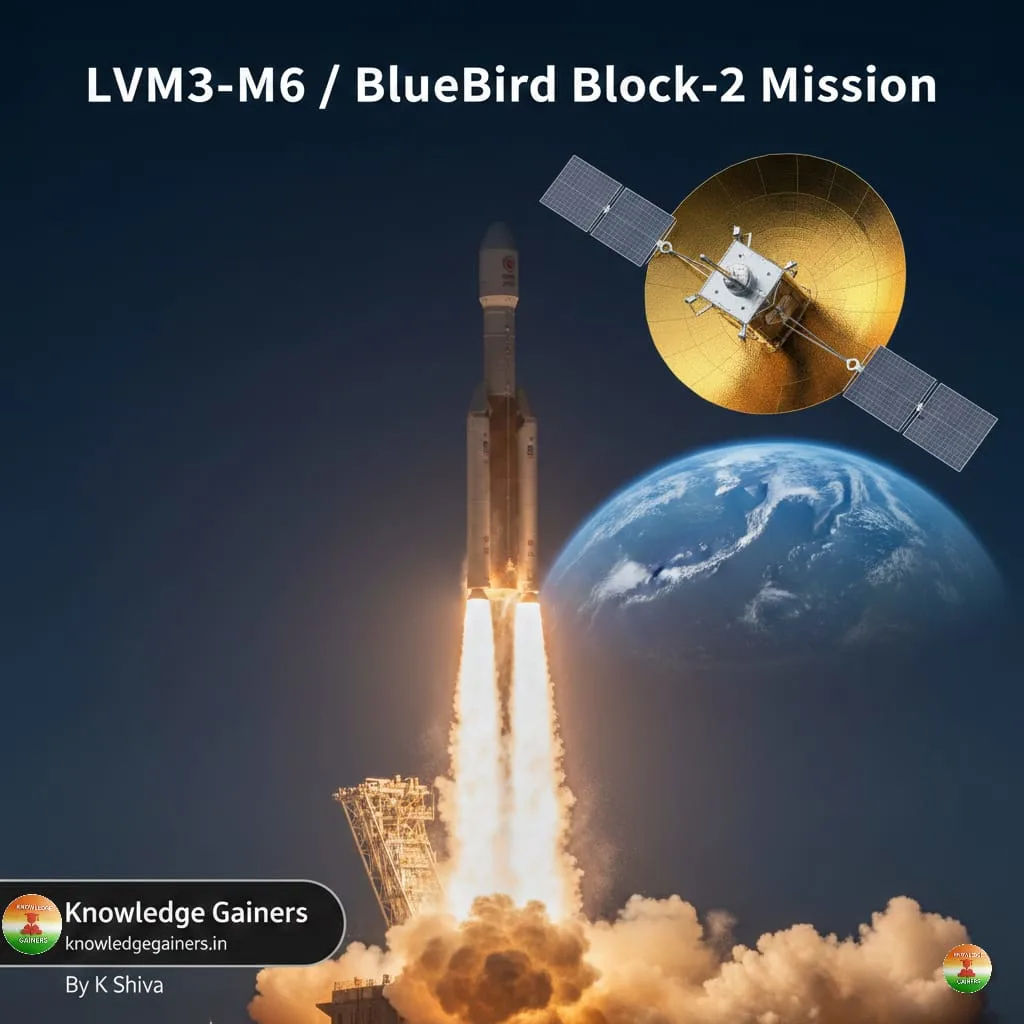
ISRO's latest major mission, as of late December 2025, was the LVM3-M6/BlueBird Block-2 mission on December 24, 2025, successfully launching the heavy US communication satellite for AST SpaceMobile, marking India's heaviest payload to date and a significant commercial success for ISRO's heavy-lift rocket. This follows the LVM3-M5/CMS-03 launch in early November 2025 and shows ISRO's growing commercial space presence with rapid launches.
On December 24, 2025, the Indian Space Research Organisation (ISRO) achieved a historic milestone by successfully launching the LVM3-M6/BlueBird Block-2 mission. Using the "Baahubali" of Indian rockets, the LVM3, ISRO deployed the heaviest payload ever launched from Indian soil: the 6,100 kg BlueBird Block-2 satellite for U.S.-based AST SpaceMobile.
Mission Overview: LVM3-M6 at a Glance
Launch Vehicle: LVM3 (formerly GSLV Mk-III), a three-stage heavy-lift rocket.
Launch Date & Time: December 24, 2025, at 08:55:30 IST.
Launch Site: Second Launch Pad, Satish Dhawan Space Centre (SDSC SHAR), Sriharikota.
Payload: BlueBird Block-2 (BlueBird 6) communications satellite.
Target Orbit: Circular Low Earth Orbit (LEO) at ~520 km altitude with a 53-degree inclination.
What is the Need for BlueBird Block-2?
Despite living in a hyper-connected age, billions of people worldwide still lack reliable mobile network coverage. Terrestrial infrastructure, like cell towers, is difficult and expensive to install in remote regions, oceans, and disaster-prone areas. The BlueBird Block-2 satellite is needed to:
Bridge the Digital Divide: Provide high-speed broadband to unconnected populations.
Eliminate Dead Zones: Ensure connectivity in mountains, deserts, and across oceans where traditional towers cannot reach.
Provide Disaster Resilience: Maintain communication when ground-based infrastructure is destroyed by natural calamities.
Functions of the Satellite
The BlueBird Block-2 is a next-generation communications satellite designed for direct-to-mobile connectivity. Its primary functions include:
Phased-Array Communication: It features a massive 223 square meter phased-array antenna—the largest commercial array ever deployed in LEO—to communicate directly with standard smartphones.
4G/5G Support: It facilitates high-speed voice calls, video calls, text messaging, and internet streaming without requiring any hardware changes to the user's mobile device.
High Data Throughput: Powered by custom AST5000 ASIC chips, it supports peak speeds of up to 120 Mbps per coverage cell.
Advantages of the Mission
Direct-to-Device Technology: Unlike traditional satellite internet that requires a dish (e.g., Starlink), this connects directly to ordinary smartphones.
Low Latency: Operating in LEO (below 1,000 km) ensures significantly lower signal delay compared to geostationary satellites.
Heaviest Payload Capability: For India, this mission proved the LVM3 can precisely deploy 6,100 kg payloads, strengthening its position in the global heavy-lift market.
Short Turnaround Time: This launch occurred just 52 days after the previous LVM3 mission, demonstrating ISRO's increased operational readiness.
Why Are We Doing This? (Purpose & Benefits)
Benefits for India
Global Market Credibility: Strengthens NewSpace India Limited (NSIL) as a reliable and cost-effective commercial launch provider.
Gaganyaan Foundation: Successful heavy-lift missions build confidence for India's upcoming human spaceflight program, Gaganyaan, which will use the same rocket.
Indo-US Cooperation: Highlights deepening strategic and technological ties between India and the United States in the space sector.
Benefits for the World
Universal Connectivity: Moves the world closer to 24/7 global cellular broadband.
Economic Impact: Access to the internet in underserved regions can unlock massive economic opportunities for local communities.
History of the Mission
The Launch Vehicle: The LVM3 (formerly GSLV Mk-III) first flew in December 2014. It has since successfully launched iconic missions like Chandrayaan-2 and Chandrayaan-3.
AST SpaceMobile Progress: Before Block-2, AST SpaceMobile launched BlueWalker 3 and BlueBird satellites 1-5 in September 2024 to test continuous coverage in select regions.
NSIL's Commercial Growth: This mission marks ISRO’s third dedicated commercial launch for the LVM3, following two OneWeb missions in 2022 and 2023.


Join our WhatsApp and Telegram Channels
Get Knowledge Gainers updates on our WhatsApp and Telegram Channels