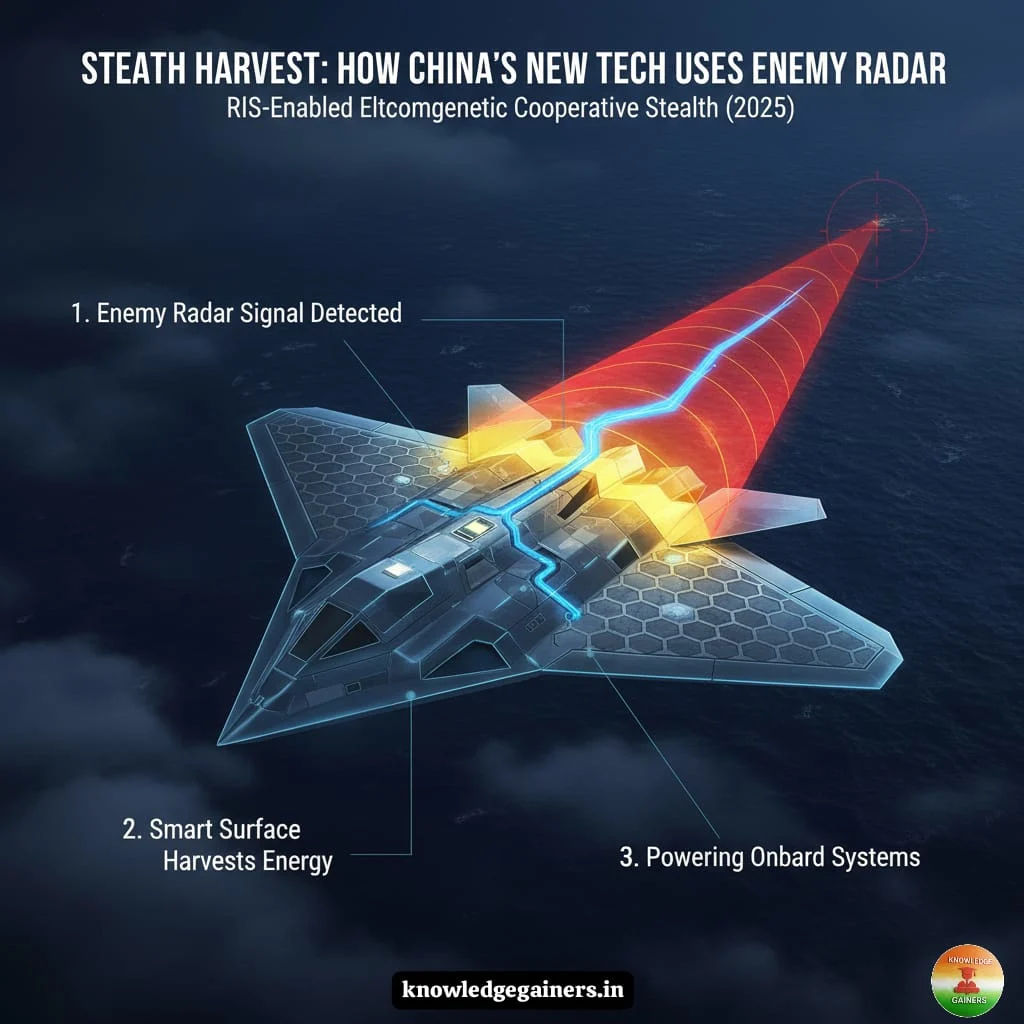
A team of researchers from Xidian University in China has unveiled a breakthrough in electromagnetic engineering: a "smart surface" that can harvest ambient electromagnetic waves—including enemy radar beams—and convert them into usable electrical power.
This innovation, known as a Reconfigurable Intelligent Surface (RIS), marks a paradigm shift where wireless signals are no longer just carriers of information, but also sources of energy. By eliminating the need for traditional batteries in complex environments, this technology is poised to redefine the future of 6G, the Internet of Things (IoT), and advanced electronic warfare.
Redefining the Stealth Game: Electromagnetic Cooperative Stealth
In the world of military defense, "stealth" traditionally means avoiding or absorbing radar signals to remain invisible. The Xidian University team has "flipped the script" with a concept called Electromagnetic Cooperative Stealth.
Radar as Fuel: Instead of simply deflecting radar, future stealth aircraft could use this RIS technology to harvest the energy from enemy radar beams to power onboard propulsion, communication, or sensing systems.

Collective Invisibility: Multiple platforms—such as a fleet of drones or jets—can work in coordination, using the smart surface to dynamically manipulate reflected waves. This reduces their collective radar cross-section, making them significantly harder for sensors to track.
The Core Technology: Reconfigurable Intelligent Surfaces (RIS)
The heart of this innovation is a two-dimensional reflecting material that acts as a programmable mirror for electromagnetic waves.
Real-Time Manipulation: The surface consists of many tiny, individually controllable elements. Using Multi-Agent Deep Reinforcement Learning (MADRL), the system can optimize robot trajectories and beamforming designs in real-time to solve complex data aggregation and path planning problems.
Battery-Free Operation: By drawing power directly from environmental signals or radar, the RIS operates as a self-sustaining system. It can also switch to a "receiver mode" to charge other electronic devices.
Overcoming Obstacles: Traditional wireless signals struggle with physical barriers like buildings. This RIS prototype can perform beam steering up to ±45°, allowing signals to "bounce" around obstructions and maintain non-line-of-sight communication.
Impact on 6G and the Internet of Robotic Things (IoRT)
Beyond its military applications, the researchers envision a broad impact on the civilian digital ecosystem, particularly in 6G communications and the Internet of Robotic Things (IoRT).
Integrated Sensing and Power: The platform combines data transmission with radar-like sensing and energy harvesting into a single hardware unit. This reduces physical space requirements and hardware costs for micro base stations and satellites.
Secure Networking: The surface can be programmed to create "radio dead zones," which helps prevent electronic eavesdropping and minimizes signal interference in crowded urban environments.
Environment-Adaptive Systems: As 6G aims to "connect everything intelligently," this architecture enables self-powered relay systems and integrated sensing that can adapt to their surroundings.
Conclusion: A New Era of Connected Systems
The Xidian University researchers, whose work was recently published in the journal National Science Review, believe this low-cost, highly programmable solution is a "pivotal" step toward more reliable robotic operations. By merging sensing, communication, and power into a unified platform, China is positioning itself at the forefront of the global 6G race, potentially gaining a decisive edge in both national security and the next-generation digital economy.


Join our WhatsApp and Telegram Channels
Get Knowledge Gainers updates on our WhatsApp and Telegram Channels