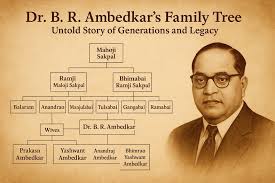
Introduction
The trajectory of modern India's socio-political, economic, and constitutional evolution is inextricably linked to the life, intellect, and relentless activism of Dr. Bhimrao Ramji Ambedkar (1891–1956). Universally acknowledged as the principal architect of the Indian Constitution, Dr. Ambedkar’s legacy extends far beyond the parameters of constitutional draftsmanship. He was a polymath of extraordinary caliber—an erudite jurist, a pioneering economist, a profound sociologist, a scholar of comparative religions, and the preeminent crusader for the civil rights of India's most marginalized populations. Born into the systemic degradation and institutionalized humiliation of the Hindu caste system, his entire life was a sustained intellectual and political rebellion against entrenched orthodoxies that sought to dehumanize millions of citizens.
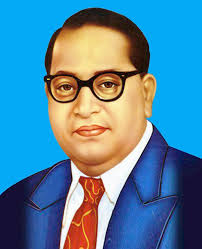
Dr. B.R. Ambedkar.
This exhaustive research report provides a detailed, granular analysis of Dr. Ambedkar's life. It systematically traces his journey from the humiliating margins of untouchability to the absolute epicenter of Indian statecraft. By rigorously examining his childhood traumas, his unparalleled educational odyssey across three continents, his tragic yet profoundly resilient personal life, and his foundational contributions to India’s constitutional, economic, and social frameworks, a nuanced portrait of his genius emerges. Furthermore, his late-in-life conversion to Buddhism and the meticulous formulation of the 22 Vows represent a profound psycho-social emancipation for India's backward classes, fundamentally altering the ideological and philosophical landscape of the subcontinent. His story is not merely a biography; it is the definitive chronicle of India's ongoing struggle for social democracy, human dignity, and egalitarian justice.
Ancestry, Birth, and the Crucible of Childhood Discrimination
Dr. B.R. Ambedkar was born on April 14, 1891, in the Mhow Army Cantonment located in the Central Provinces (present-day Madhya Pradesh). He was the fourteenth and final child of Subedar Ramji Maloji Sakpal and Bhimabai Sakpal. The family belonged to the Mahar caste, a community historically designated as 'untouchable' and relegated to the absolute bottom of the Brahminical social hierarchy. However, the Mahar community also possessed a robust and proud military tradition, tracing their service back to the armies of the East India Company, which afforded them a degree of discipline, exposure, and socio-economic stability uncommon among other depressed classes.
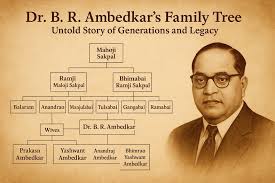
Dr.B.R. Ambedkar family tree
The family's original surname was 'Sakpal', which was traditionally accompanied by the village identifier 'Ambadawekar', denoting their ancestral roots in the Ambadawe village situated in the Ratnagiri district of Maharashtra. Despite his father's respected rank as a Subedar in the British Indian Army, the family could not escape the pervasive and inescapable shadow of caste prejudice. When Ramji Sakpal retired barely two years after Bhimrao's birth, the family relocated to Satara, Maharashtra, and subsequently to Koregaon, triggering a sharp decline in their economic stability. Tragedy struck the family early and devastatingly; Bhimabai passed away in 1896 when Bhimrao was just five years old. This loss left him and his surviving siblings—his brothers Balaram and Anandrao, and his sisters Manjula and Tulasa—in the care of their paternal aunt, who moved in to manage the struggling household.
.webp?updatedAt=1776174777739)
Pune Pact (24th September 1932).
It was during his primary schooling in Satara that the young Bhimrao first encountered the brutal, systemic realities of untouchability. The empirical evidence of his childhood trauma is vividly captured in his later autobiographical reflections, most notably in his poignant essay Waiting for a Visa. In the educational environment, he and his brother were completely segregated from upper-caste students. They were forced to sit in the extreme corner of the classroom on a gunny sack, which they were required to bring from home and carry back daily, as the school peon and upper-caste staff refused to touch it for fear of ritual pollution.
.webp?updatedAt=1776174779660)
Simon Commission (1928).
Even more dehumanizing was the draconian restriction placed on drinking water. Untouchable children were strictly forbidden from touching the communal water tap or the vessels that contained it. Water could only be poured into their mouths from a significant height by a caste Hindu, usually the school peon. If the peon was absent, Bhimrao was forced to go thirsty for the entire school day—a paradigm of systemic exclusion he famously and bitterly summarized with the phrase, "No peon, no water". These early experiences of structural violence and ostracization were not merely biographical footnotes; they formed the epistemic foundation for his later constitutional philosophy, driving his uncompromising insistence that basic civic accessibility must be a justiciable, fundamental right rather than a matter of upper-caste benevolence or charity.
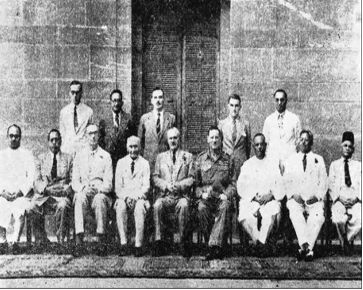
Dr.Babasaheb Ambedkar with Lord Wavell.
Educational Odyssey: Defying the Odds Across Continents
Of all the siblings in the Sakpal family, only Bhimrao possessed the relentless academic tenacity to pass his examinations and proceed to high school. To facilitate his education, the family relocated to the metropolis of Bombay, where, in 1897, he became the first Dalit student to enroll at the prestigious Elphinstone High School. Even in this urban, ostensibly progressive institution, discrimination persisted unabated. Despite harboring a deep desire to study Sanskrit—the linguistic key to understanding Hindu scriptures—he was explicitly barred from doing so because the sacred texts were deemed strictly off-limits to untouchables. Consequently, he was forced, against his will, to choose Persian as his classical language.
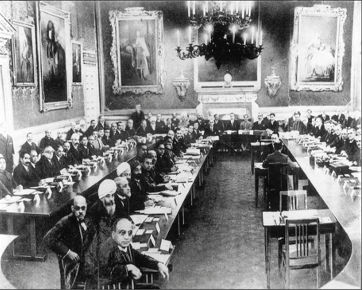
First Round Table
During his high school years, a transformative interaction occurred that would alter his identity forever. A Marathi Brahmin teacher named Krishnaji Keshav Ambedkar, who held deep affection and respect for the young boy's intellect, officially changed Bhimrao's surname in the school records from 'Ambadawekar' to his own surname, 'Ambedkar'. This act of individual kindness stood in stark contrast to the systemic cruelty he faced daily. In 1907, Ambedkar passed his matriculation examination, an achievement of such unprecedented magnitude for the marginalized Mahar community that it was celebrated with a public felicitations presided over by the well-known Maharashtrian social reformer S.K. Bole.
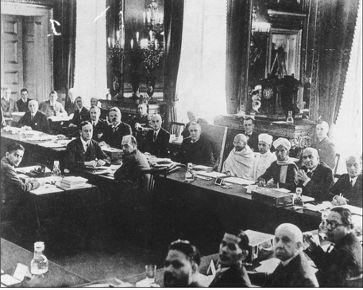
Second Round Table.
Higher Education in India and the American Transformation
Ambedkar's stellar academic performance caught the attention of progressive royals who recognized his immense potential. Financed by a vital scholarship from Sayajirao Gaikwad, the visionary Maharaja of Baroda, he completed his Bachelor of Arts (B.A.) in Economics and Political Science from Elphinstone College, Bombay University, in 1912. Recognizing his unparalleled intellect, the Maharaja awarded him a state scholarship in 1913 to pursue postgraduate studies at Columbia University in New York, United States.
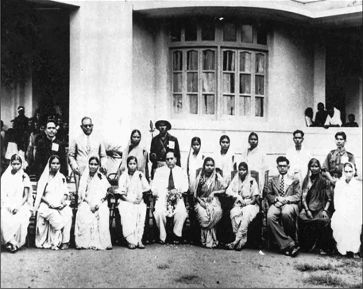
Felicitation of Dr.Babasaheb Ambedkar by the Mahila Samaj
This transatlantic voyage was intellectually, socially, and psychologically emancipating. Free from the daily humiliations and restrictive boundaries of the Indian caste system, Ambedkar immersed himself in Western liberal, pragmatic, and democratic philosophy. At Columbia, he studied under some of the greatest intellectual giants of interwar American liberalism, such as the philosopher John Dewey, the economist Edward Seligman, and historians James Shotwell and James Harvey Robinson. John Dewey’s pragmatic philosophy, which emphasized democracy not merely as a governmental mechanism but as an "associated mode of living" grounded in social equality, profoundly and permanently influenced Ambedkar's later definitions of social democracy and constitutional morality.
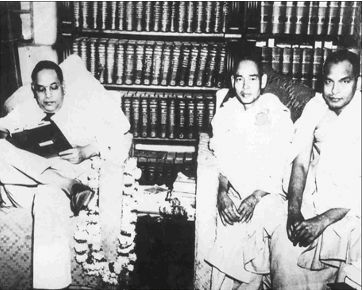
Dr. Babasaheb in his Library
In 1915, he obtained his Master of Arts (M.A.), with his thesis meticulously analyzing "The Administration and Finance of the East India Company". The following year, he submitted his groundbreaking Ph.D. dissertation, "The Evolution of Provincial Finance in India: A Study in the Provincial Decentralization of Imperial Finance," officially receiving his doctorate in 1927. Furthermore, he presented a seminal anthropological paper, Castes in India: Their Mechanism, Genesis and Development, in a 1916 academic seminar led by Alexander Goldenweiser. This paper marked his first scholarly dissection of the caste system's endogamous origins, arguing that caste was an enclosed class maintained by strict marital restrictions.
The London School of Economics and the Struggle for Qualifications
In 1916, Ambedkar departed New York for London, enrolling concurrently at the London School of Economics and Political Science (LSE) for a master's degree in economics and at Grey's Inn to study law for the Bar. However, his Baroda state scholarship expired in 1917, abruptly forcing him to abandon his studies and return to India. Working as a Professor of Political Economy at Sydenham College in Bombay in 1918, he painstakingly saved money, supplemented by crucial financial assistance from Chhatrapati Shahuji Maharaj of Kolhapur and a personal loan from a friend.
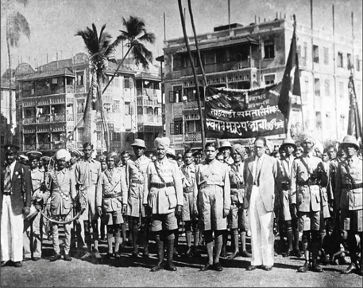
Labour Minister Dr.Babasaheb Ambedkar with miners
With these funds, he returned to London in 1920 to complete his interrupted education. In 1922, he was called to the Bar at Grey's Inn, officially becoming a barrister-at-law. He also completed both his Master of Science (M.Sc.) in 1921 and his Doctor of Science (D.Sc.) from the LSE in 1923. His doctoral thesis at LSE, "The Problem of the Rupee: Its Origin and Its Solution," was a masterpiece of monetary economics that became a foundational text in shaping Indian central banking.
Table 1: Dr. B.R. Ambedkar's Educational Milestones
Academic Institution | Degree/Achievement attained | Year Completed | Key Thesis/Subject of Focus |
Elphinstone High School | Matriculation Examination | 1907 | Persian (Scored Highest Marks) |
Bombay University | Bachelor of Arts (B.A.) | 1912 | Economics and Political Science |
Columbia University | Master of Arts (M.A.) | 1915 | Administration & Finance of the East India Company |
Columbia University | Doctor of Philosophy (Ph.D.) | 1916 (Awarded 1927) | Evolution of Provincial Finance in India |
London School of Economics | Master of Science (M.Sc.) | 1921 | Provincial Decentralization of Imperial Finance |
Grey's Inn | Barrister-at-Law | 1922 | Legal Studies and Jurisprudence |
London School of Economics | Doctor of Science (D.Sc.) | 1923 | The Problem of the Rupee: Its Origin and Its Solution |
Personal Life: Marriages, Tragedies, and Family Sacrifices
Behind the towering public intellect and the ferocious political crusader was a personal life marked by profound sacrifice, systemic poverty, and recurrent tragedy. In 1906, at the tender age of 15, Ambedkar was married to Ramabai, who was then merely nine years old, in a traditional match arranged by their respective families.
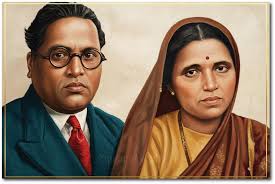
ambedkar with first wife Ramabai
Ramabai served as the silent, suffering, yet unbreakable pillar of the Ambedkar household. While Dr. Ambedkar was abroad in New York and London pursuing his advanced degrees, the family in India lived in acute financial distress. Ramabai meticulously shielded her husband from the full, devastating extent of their poverty. She absorbed the daily hardships of managing a destitute household, purposefully keeping the financial crises hidden in her letters so that he could focus entirely on his studies, knowing that his academic success was the only pathway to achieving his life's goal of eliminating caste discrimination.

Dr. Babasaheb and Mrs. Maisaheb with Rajgopalchari family
The couple suffered agonizing personal losses, bearing the brunt of poor healthcare and poverty. They welcomed six children—Yashwant, Gangadhar, Ramdesh, Indu, and Rajratna. However, infant mortality, exacerbated by their difficult circumstances, claimed four of them. The death of his youngest and most beloved son, Rajratna, in 1926 plunged Ambedkar into a grief so deep and debilitating that he reportedly refused to part with the child's body, locking himself in the room where the infant had breathed his last for days together. Only their eldest son, Yashwant (also known as Bhaiyasaheb), survived to adulthood, eventually continuing his father's socio-political legacy as the President of the Buddhist Society of India and a member of the Maharashtra Legislative Council. Ramabai, chronically ill, bedridden since January 1935, and weakened by decades of relentless hardship, passed away on May 27, 1935. In profound mourning, Ambedkar tonsured his head as a traditional mark of grief and retreated into severe depressive episodes, undergoing treatment at an Ayurvedic center in Lonavala for persistent physical and psychological distress.
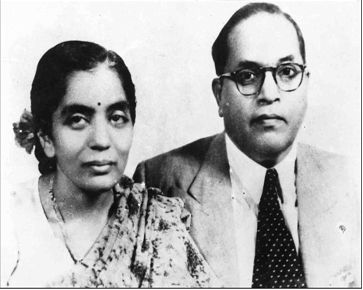
Dr.Babasaheb Ambedkar with his Second Wife Dr.Savita Ambedkar
For over a decade, Ambedkar remained a widower, utterly consumed by the monumental tasks of drafting the Constitution of India and leading nationwide political agitations. By the late 1940s, however, the immense stress of his work began to take a severe toll on his physical health. He suffered from critical diabetes, neuropathic pain, and dangerous high blood pressure. In 1947, while engaged in the grueling constitutional drafting process, he traveled to Bombay to seek specialized medical treatment. There, he was examined and attended by Dr. Sharada Kabir, a highly educated medical practitioner who was 39 years his junior. Bound by a mutual intellectual affinity and a shared, deep interest in the teachings and values of Gautama Buddha, the two exchanged approximately forty to fifty letters over a year before Ambedkar proposed marriage.
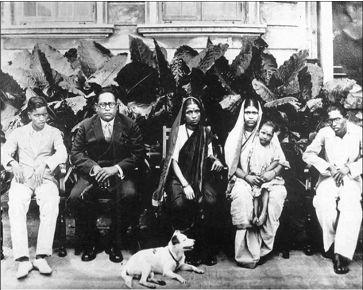
Dr.Babasaheb's Family Circle.
They were married on April 15, 1948, when Ambedkar was 57 and Dr. Kabir was 39. Following her marriage, she adopted the name Savita Ambedkar (affectionately referred to by followers as Maisaheb). Dr. Ambedkar explicitly credited her rigorous medical care, dietary management, and intellectual companionship with extending his life by 8 to 10 critical years, affording him the vitality necessary to complete his constitutional drafting and his final literary works. Savita Ambedkar survived him by many decades, converting to Buddhism alongside him and remaining a prominent, active figure in the Dalit Buddhist movement until her death in 2003.
Table 2: The Ambedkar Family Lineage
Relation | Name | Lifespan | Historical Notes and Significance |
Father | Ramji Maloji Sakpal | 1838–1913 | Subedar in British Indian Army; relocated family for education |
Mother | Bhimabai Sakpal | ?–1896 | Passed away when Ambedkar was only five years old |
First Wife | Ramabai Ambedkar | 1898–1935 | Endured extreme poverty to support Ambedkar's foreign education |
Second Wife | Savita Ambedkar (Sharada Kabir) | 1909–2003 | Medical doctor; credited with extending his life through crucial care |
Son | Yashwant (Bhaiyasaheb) Ambedkar | 1912–1977 | Sole surviving child; politician and President of Buddhist Society |
Deceased Children | Gangadhar, Ramdesh, Indu, Rajratna | - | Passed away in infancy due to poverty and lack of medical access |
Grandson | Prakash Yashwant Ambedkar | 1954–Present | Prominent politician; leader of the Vanchit Bahujan Aghadi |
Grandson | Anandraj Ambedkar | 1967–Present | Political leader of the Republican Sena |
The Dawn of Activism: Agitations and Institution Building
Upon returning to India permanently in the 1920s, armed with multiple doctorates and prestigious legal qualifications, Ambedkar entered the Baroda Public Service as a military secretary to the Gaekwad, fulfilling the bond of his scholarship. However, despite his unparalleled academic pedigree, he was subjected to brutal, systemic indignities by his upper-caste subordinates. Clerks and peons threw files at his desk from a distance to avoid 'pollution'. Unable to secure lodging in the city—as Parsi and Hindu innkeepers refused to house an untouchable—he was forced into the humiliating position of having to resign his post and return to Bombay, where he commenced private legal practice and teaching.
.webp?updatedAt=1776174778931)
Establishment of Milind Mahavidyalaya (1st September 1950).
This period marked his definitive transition from a purely academic scholar to an insurgent, militant activist. He recognized with crystal clarity that upper-caste benevolence would never voluntarily dismantle untouchability; the marginalized needed collective political power, self-representation, and robust institutional backing. In 1924, he founded the Bahishkrit Hitakarini Sabha (Outcastes Welfare Association) to promote education, socio-economic upliftment, and a fierce sense of self-respect among the depressed classes.
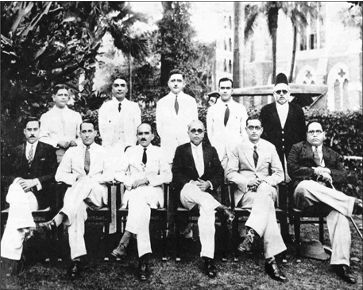
Dr.Babasaheb Ambedkar Principal of Government Law College.
A critical realization for Ambedkar was the absolute necessity of institutional building. He fundamentally believed that education was the ultimate emancipatory tool, famously exhorting his followers to "Educate, Agitate, Organize". To this end, he founded the People's Education Society (PES) on July 8, 1945. The PES was established not merely to confer degrees, but to forge a new intellectual vanguard capable of challenging Brahminical hegemony. The society was instrumental in establishing premier educational institutions across Maharashtra and beyond, including the Siddharth College of Arts, Science and Commerce in Mumbai (1946) and the Milind College of Arts and Science in Aurangabad (1950). These institutions were revolutionary because they aggressively promoted higher education among Buddhists, Scheduled Castes, Scheduled Tribes, and Other Backward Classes (OBCs), thereby democratizing access to intellectual capital and fulfilling Ambedkar's vision of creating a true social democracy through "Education to All".
Table 3: Key Institutions Founded by the People's Education Society (PES)
Institution Name | Location | Focus Area / Significance |
Siddharth College of Arts, Science and Commerce | Mumbai | Pioneer institution offering multi-disciplinary higher education to the marginalized |
Siddharth College of Law | Mumbai | Dedicated to producing legal scholars from backward classes to fight judicial battles |
Milind College of Arts and Science | Aurangabad | Brought premier higher education to the historically backward Marathwada region |
Dr. Ambedkar College of Law | Aurangabad | Focus on producing legal advocates equipped in constitutional and labor laws |
Dr. B.R. Ambedkar College of Education | Bodh Gaya, Bihar | Educational expansion into northern India with a focus on teacher training |
Navigating the Independence Movement and Political Formations
Ambedkar's relationship with the mainstream Indian independence movement, which was predominantly spearheaded by the Indian National Congress and Mahatma Gandhi, was highly complex, fraught with tension, and frequently adversarial. While the Congress prioritized absolute political independence from British colonial rule, Ambedkar posited a radically different thesis: transferring power to an orthodox, elite Hindu majority without first dismantling the oppressive caste system would merely replace foreign colonialism with domestic, high-caste tyranny. He asserted that social democracy was a strict, non-negotiable prerequisite for political democracy.
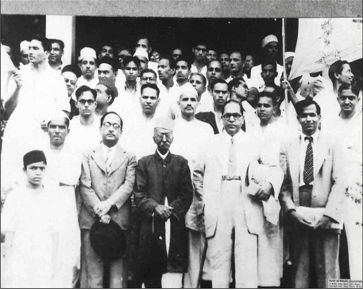
The National Flag Committee.
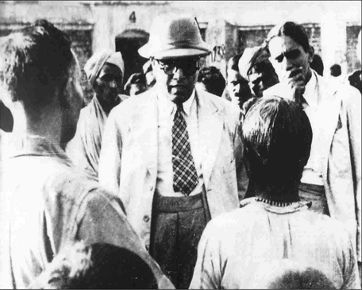
Dr.Babasaheb Ambedkar and the Representative of the Indian Labour Party.
His activism was characterized by direct, confrontational mass movements that shocked the conservative establishment. In 1927, he led the historic Mahad Satyagraha, leading thousands of Dalits to march to and drink water from the Chavadar tank, a public reservoir that was previously restricted exclusively to caste Hindus. Later that year, in a profound and explosive symbolic repudiation of Brahminical orthodoxy, he and his followers publicly burned the Manusmriti, the ancient Hindu legal text that codified draconian caste laws and sanctioned the severe degradation of women and Shudras. These actions irrevocably shifted the Dalit struggle from a paradigm of requesting upper-caste 'charity' and temple-entry to a militant demand for fundamental civic, legal, and human rights.
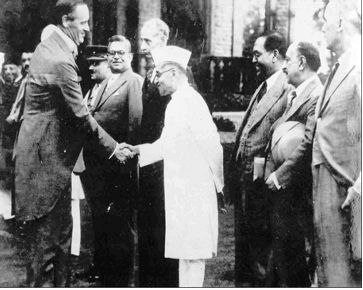
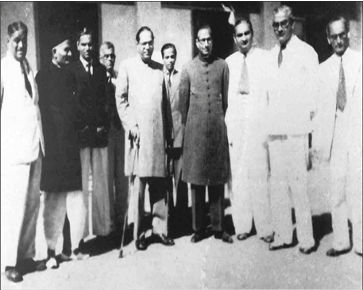
Dr.Ambedkar, Shri K.M.Munshi & others with Sir Cripps.
Politically, Ambedkar sought to secure autonomous, statutory representation for the depressed classes to prevent them from being perpetually outvoted by the Hindu majority. His demand for separate electorates for untouchables, conceded by the British Prime Minister Ramsay MacDonald in the Communal Award of 1932, was fiercely opposed by Mahatma Gandhi, who viewed it as a move that would permanently divide the Hindu fold. Gandhi undertook a fast unto death in the Yerwada Central Jail in Pune to protest the award. Under immense moral blackmail, public pressure, and the fear of massive reprisals against Dalits if Gandhi died, Ambedkar was forced to compromise. This resulted in the Poona Pact of 1932, which replaced separate electorates with reserved seats for depressed classes within the general Hindu electorate. This event cemented his lifelong skepticism of the mainstream nationalist leadership's commitment to genuine social equity.
People's Education Society.
Realizing the need to consolidate independent political power, Ambedkar founded the Independent Labour Party (ILP) in 1936. The ILP was a moderately socialist platform that opposed both the capitalist hegemony of the mill owners and the casteist hegemony of the landlords, famously winning 15 of the 17 seats it contested in the 1937 Bombay Assembly elections. However, recognizing the need for a pan-Indian identity specifically tailored to Dalits, he dissolved the ILP and formed the All India Scheduled Castes Federation (SCF) in 1942 as a popular, nationwide political front.
.webp?updatedAt=1776174777698)
Chavdar Tale Satyagrah at Mahad (25th December 1927).
During this highly volatile era, he also authored his most devastating, brilliant critique of Hindu society, Annihilation of Caste (1936). Originally prepared as a presidential address for the Jat-Pat Todak Mandal, a reformist Hindu group in Lahore, the invitation was rescinded when the conservative organizers read his radical draft. Refusing to alter a single word, Ambedkar published it himself. The text systematically argued that caste was not merely a benign division of labor, but a cruel division of laborers, maintained through "graded inequality" and endogamy. He concluded that caste could not be reformed through cosmetic measures like inter-dining or inter-marriage alone; it required the total, absolute destruction of the religious scriptures and dogmas that sanctioned it.
Architect of the Indian Republic: Constitutional and Social Justice
With the dawn of India's independence in 1947, Prime Minister Jawaharlal Nehru, recognizing Ambedkar's unparalleled legal, economic, and constitutional acumen, invited him to join the first cabinet of independent India as the Minister of Law. Shortly thereafter, the Constituent Assembly appointed him Chairman of the Drafting Committee, entrusting him with the monumental, historically unprecedented task of framing the Republic's foundational legal and political document.
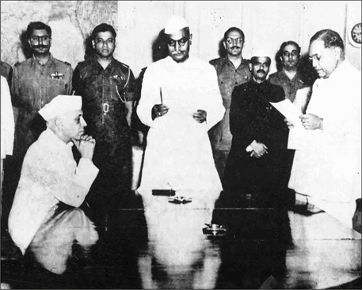
Dr. Babasaheb Ambedkar taking the oath.
.webp?updatedAt=1776174779247)
The Constitution Committee (29th August 1947).
Ambedkar's stewardship of the Constitution was a masterclass in synthesizing Western democratic principles with the highly specific sociological, religious, and economic complexities of the Indian subcontinent. His interventions during the Constituent Assembly debates were marked by scrupulous research, intellectual rigor, and an unwavering commitment to the marginalized.
Fundamental Rights and Eradicating Social Injustice
For Ambedkar, the Constitution was not merely a mechanical, administrative framework for governance, but an active instrument for profound social revolution. Having intimately experienced the brutality of caste, he embedded robust, non-negotiable safeguards for marginalized communities. He championed Part III of the Constitution (Fundamental Rights), ensuring the inclusion of Article 15 (which strictly prohibits discrimination on grounds of religion, race, caste, sex, or place of birth) and the historic Article 17, which explicitly abolished "Untouchability" in all its forms and criminalized its practice.
.webp?updatedAt=1776174779349)
Submission of the draft of the Indian Constitution (February 1948).
Federalism and the Doctrine of Constitutional Morality
On the structure of the state, Ambedkar strongly advocated for a federal system with a sufficiently strong center to prevent the Balkanization of the diverse country, while ensuring that States possessed co-equal legislative and executive sovereignty within their domains. He warned that political stability should never supersede democratic accountability, thereby prioritizing a parliamentary system over a presidential one.
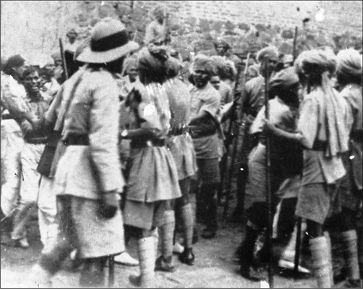
Kalaram Mandir Satyagrah.
Crucially, he introduced the profound concept of Constitutional Morality to the Indian political discourse. Ambedkar posited that the mere existence of a written constitution does not guarantee a functional democracy. He argued that constitutional morality—a deep reverence for constitutional forms, tolerance of opposing political views, and the absolute willingness of the majority to not trample the minority—is "not a natural sentiment. It has to be cultivated". He feared that in a deeply unequal society governed by rigid caste loyalties, the lack of constitutional morality would lead to democracy becoming merely a "top dressing on an Indian soil, which is essentially undemocratic". This foresight remains incredibly relevant today, frequently cited by the Supreme Court of India in landmark judgments (such as Navtej Singh Johar vs. Union of India, which decriminalized homosexuality) to assert that constitutional morality must always prevail over majoritarian social morality or popular prejudices.
Advocacy for Other Backward Classes (OBCs)
While Ambedkar is globally recognized primarily as a Dalit icon, his constitutional vision extensively and explicitly encompassed the "Shudras" or Other Backward Classes (OBCs). He possessed the sociological foresight to recognize that the structural backwardness of these vast communities required aggressive state intervention. Consequently, he was instrumental in conceptualizing and embedding Article 340 into the Constitution. This article empowered the President of India to appoint a commission to rigorously investigate the conditions of socially and educationally backward classes and recommend affirmative action measures. It was directly under this provision that the Kaka Kalelkar Commission (1953) and, crucially, the later Mandal Commission were established, laying the entire legal groundwork for OBC reservations in modern India and proving that his advocacy transcended his own caste identity.
Post-Independence Contributions: Economic Vision and the Hindu Code Bill
While his legal and social contributions dominate public memory, Ambedkar was foremost a highly trained, globally recognized economist. His 1923 doctoral thesis, The Problem of the Rupee, masterfully analyzed the inflation and exchange rate fluctuations in colonial India, arguing forcefully against the gold-exchange standard. When the Hilton Young Commission (formally the Royal Commission on Indian Currency and Finance) arrived in India in 1927, Ambedkar provided a comprehensive testimony outlining frameworks for monetary stability. His empirical research and structural recommendations heavily influenced the Commission, which directly led to the conceptualization and formal establishment of the Reserve Bank of India (RBI) in 1935.
As an economic thinker, Ambedkar recognized that social exploitation was deeply and symbiotically intertwined with economic disenfranchisement. He vehemently advocated for state-led industrialization, equitable land reforms, and the nationalization of key industries and agricultural land—frameworks that resonate deeply with modern sustainable development goals. He perceived that agrarian feudalism kept Dalits perpetually indentured to upper-caste landowners, making economic decentralization and urbanization vital for achieving social liberty.
The Hindu Code Bill and Women's Emancipation
As the first Law Minister, Dr. Ambedkar embarked on his most ambitious legislative project: the codification and reform of Hindu personal laws. He considered this mission absolutely essential for the modernization of Indian society and the emancipation of women. The Hindu Code Bill sought to unify the scattered, patriarchal provisions of the Mitakshara and Dayabhaga systems, directly challenging the conservative core of orthodox Hinduism.
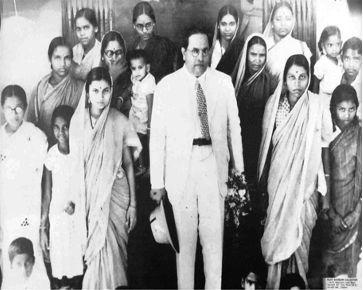
Dr.Ambedkar with the women delegates of the Scheduled Castes Federation.
The Bill's provisions were revolutionary for their time. It was structured into four independent acts that sought to entirely dismantle male privilege in family structures. It sought to grant women absolute legal rights to inherit family property (the Hindu Succession Act), introduced the legal right to file for divorce and claim maintenance (the Hindu Marriage Act), allowed women to legally adopt children independently (the Hindu Adoption and Maintenance Act), and recognized the mother as the natural, equal guardian of her child (the Hindu Minority and Guardianship Act).

Dr.Babasaheb Ambedkar with his colleagues of Nandgaon in hotel.
However, the Bill faced ferocious, unrelenting backlash from orthodox Hindu elements both inside and outside the Parliament. Prominent figures, including the President of India, Dr. Rajendra Prasad, fiercely opposed the reforms, desiring their indefinite postponement. This intense conservative pressure led the government, despite Prime Minister Nehru's initial support, to stall, dilute, and fragment the legislation. Deeply frustrated by the lack of political will to ensure gender equality, and viewing the withdrawal of the comprehensive Bill as a fundamental betrayal of constitutional principles, Dr. Ambedkar resigned from the Nehru cabinet in September 1951, sacrificing political power for his principles.
The Spiritual Revolution: Conversion to Navayana Buddhism
Dr. Ambedkar's final, and perhaps most enduring, act of defiance was spiritual and religious. As early as October 13, 1935, at a massive conference in Yeola, he had taken a solemn, historic vow: "Even though I was born a Hindu, I will not die a Hindu". Over the next two decades, he meticulously studied the theology, sociology, and political implications of Sikhism, Christianity, and Islam, searching for a religion that aligned with his core tenets of rationality, equality, and fraternity.
.webp?updatedAt=1776174777892)
Embraced Buddhism at Nagpur (14th October 1956).
He ultimately chose Buddhism, but not the traditional Mahayana, Theravada, or Vajrayana schools, which he felt had accumulated their own dogma. He subjected ancient Buddhist texts to a rigorous rationalist critique, stripping away elements of mysticism, karma-based rebirth, and strict asceticism to formulate Navayana (Neo-Buddhism). For Ambedkar, Navayana Buddhism was an engaged, ethical, and social philosophy specifically designed to remove human suffering and foster a society based on Prajna (understanding), Karuna (compassion), and Samata (equality). His monumental text, The Buddha and His Dhamma, served as the holy book for this new movement.
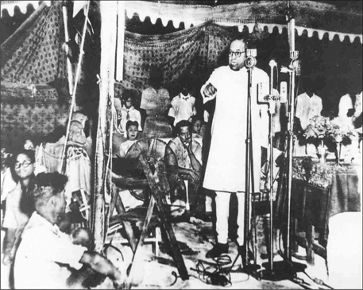
Buddhist Conference at Rangoon.
On October 14, 1956, at Deekshabhoomi in Nagpur, Ambedkar and an estimated 400,000 to 500,000 of his followers formally embraced Buddhism. This was a watershed moment in global religious history—a mass conversion driven not by coercion or missionary zeal, but by a collective intellectual and social rejection of an oppressive, graded caste hierarchy.
.webp?updatedAt=1776174779484)
Buddha Jayanti at Delhi (2nd May 1951).
The 22 Vows: A Blueprint for Social Severance
To ensure a complete, irreversible psycho-social severing from the Brahminical order, Ambedkar administered 22 specific vows to his followers during the conversion ceremony. These vows functioned as both a theological break and a moral compass, ensuring the converts did not carry Hindu caste prejudices into their new Buddhist identity.

Dr. Babasaheb and Maisaheb on their way to the conference at Kathmandu.
Table 4: Analytical Breakdown of Dr. Ambedkar's 22 Vows
Ideological Category | Core Objective | Specific Vows Administered (Abridged) |
Theological Break | Total rejection of the Hindu pantheon and Avatar theory | Vows 1-5: "I shall have no faith in Brahma, Vishnu and Mahesh... nor in Rama and Krishna. I do not believe Buddha was the incarnation of Vishnu." |
Ritualistic Break | Rejection of Brahmin-led rites and hereditary superstitions | Vows 6, 8: "I shall not perform Shraddha... I shall not allow any ceremonies to be performed by Brahmins." |
Moral Code | Adoption of Buddhist Panchsheel (Five Precepts) | Vows 11-15: "I shall not tell lies... commit sexual misconduct... consume liquor. I shall endeavour to follow the Noble Eightfold Path." |
Social Creed | Absolute declaration of human equality and rebirth | Vows 19-21: "I renounce Hinduism which impedes advancement because it is based on inequality... I believe by adopting Buddhism I am having a re-birth." |
This act fundamentally redefined the identity of millions. By actively discarding the stigmatized identity of "untouchables" and adopting the empowered identity of "Buddhists," Dalits claimed a noble, egalitarian, and pan-Asian spiritual heritage, effectively neutralizing the psychological conditioning of caste inferiority.
.webp?updatedAt=1776174779574)
The Buddhist Conference at Kathmandu (15-20 November 1956)
Final Days, Death, and the Ultimate Message
By the late 1950s, the physical toll of his lifelong, solitary struggles was starkly evident. Suffering from severe, uncontrolled diabetes and deteriorating eyesight, Ambedkar spent his final months desperately trying to finalize his magnum opus on religion, The Buddha and His Dhamma.
.webp?updatedAt=1776174779345)
Visit to Sarnath (24th November 1956).
Intimate accounts from his personal secretary, Nanak Chand Rattu, reveal the poignant, high-pressure atmosphere of his final days. On the evening of December 5, 1956, after returning from an appointment, a physically weary and emotionally drained Ambedkar experienced a brief burst of temper due to a misunderstanding with his wife, Savita, which Rattu helped pacify. He met a delegation of Jain leaders later that night, exhibiting clear signs of severe exhaustion, before retreating to his bedroom.
.webp?updatedAt=1776174776121)
Visit to Ellora caves (1st September 1950).
Sometime during the night, Dr. B.R. Ambedkar passed away peacefully in his sleep at his residence at 26, Alipur Road, New Delhi. The date was December 6, 1956. His sudden passing, observed annually by his followers as Mahaparinirvan Din, sent profound shockwaves across the nation. He was cremated at Dadar Chowpatty in Bombay (now revered as Chaitya Bhoomi) with full state honors, surrounded by a massive, inconsolable sea of hundreds of thousands of grieving followers.
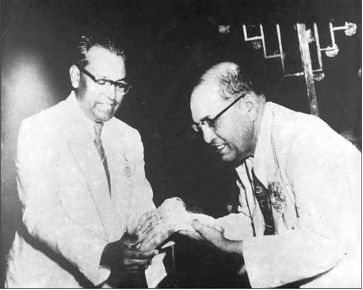
Grant of Rs. 1,18,000.
His last message to his people, delivered implicitly through his final speeches in December 1956 and explicitly conveyed by his closest associates, was a stark, uncompromising reminder of civic and communal duty: "Pay back to society". He warned that the benefits of education, bureaucratic positions, and political power achieved by individual Dalits must not be selfishly hoarded; the educated youth bore an intense moral responsibility to return and uplift the illiterate, suffering masses they left behind in the villages.
Legacy: Transforming Indian Thought and Empowering Backward Classes
Dr. Ambedkar's macro-impact on the Indian intellectual, sociological, and political landscape is without historical parallel. Prior to his emergence, the mainstream discourse surrounding "untouchability" was largely, and patronizingly, framed by upper-caste reformers as an issue of religious purification or charitable upliftment (as evidenced by Gandhi's Harijan movement). Ambedkar radically and permanently ruptured this paradigm. He articulated that caste was a systemic violation of fundamental human rights and required absolute political power, constitutional guarantees, and aggressive socio-economic restructuring to be dismantled.
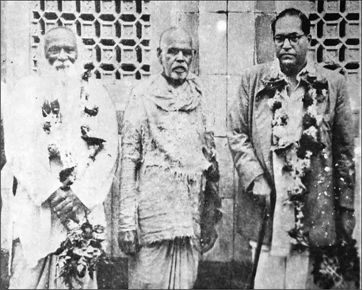
Chokhamela Dharmashala and Dr. Ambedkar.
Through highly controversial and seminal texts like Who Were the Shudras? (1946), he challenged both Western colonial historians and orthodox Brahminical narratives. By meticulously analyzing Sanskrit and Pali texts, he posited that Shudras were originally part of the Kshatriya varna but were deliberately degraded due to prolonged ideological and physical conflicts with Brahmins, thereby providing immense historical dignity to the marginalized and unmasking the artificially constructed nature of caste hierarchy.

Dr. Babasaheb Ambedkar paying his last respect to Mahatma Gandhiji.
His rigorous ideological framework successfully morphed India's marginalized classes from passive recipients of upper-caste sympathy into aggressive, legally conscious stakeholders in the democratic process. The political parties he founded paved the direct intellectual way for modern Dalit and Bahujan political formations, effectively shifting the balance of power in Indian electoral politics. Furthermore, by insisting on the inclusion of Article 340, he foresaw that the struggle for true equality extended beyond the untouchables to the vast multitude of Other Backward Classes (OBCs). By identifying their lack of collective consciousness and tendency toward "Sanskritisation" (mimicking upper castes), he laid the analytical foundation for the contemporary social justice and reservation movements in modern India.
.webp?updatedAt=1776174779064)
Bharatratna - Dr. Babasaheb Ambedkar (14th April 1990).
In conclusion, Dr. B.R. Ambedkar's life was a testament to the supreme triumph of human will, rationality, and legal brilliance over the most entrenched, ancient systems of oppression known to history. From the indignity of sitting on a gunny sack in Satara to presiding over the drafting of the constitution of the world's largest democracy, his journey is the quintessential narrative of subaltern empowerment. His brilliance lay in his holistic approach to human liberation; he understood that political freedom without economic equality would breed authoritarianism, and economic equality without social fraternity would render justice meaningless. Posthumously awarded the Bharat Ratna in 1990, his legacy endures not merely in bronze statues or constitutional clauses, but in the vibrant, ongoing global struggle for a truly egalitarian society, forever echoing his eternal, emancipatory salutation: Jai Bhim.
Join our WhatsApp and Telegram Channels
Get Knowledge Gainers updates on our WhatsApp and Telegram Channels