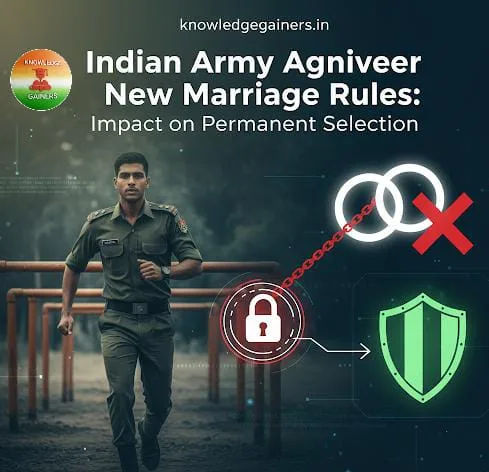
The implementation of the Agnipath scheme on June 14, 2022, represented a transformative pivot in the human resource management strategy of the Indian Armed Forces. This reform aimed to create a more agile, youthful, and technologically proficient military structure by introducing a short-service tenure of four years for personnel designated as Agniveers. Beyond the structural alterations to service duration and pension liabilities, the scheme introduced a rigorous set of behavioral and eligibility mandates, most notably the requirement for candidates to remain unmarried throughout their four-year engagement and the subsequent evaluation period for permanent induction. This policy, visually underscored by official communications stating No-Marriage Allowed for Agniveers until permanent appointment, is rooted in the institutional objective of ensuring that soldiers in their most formative years of military development remain entirely focused on rigorous training and operational readiness. This report provides an exhaustive analysis of these marriage regulations, the performance-based selection criteria for permanent service, and the broader socio-legal and operational implications of the Agnipath model within the context of 21st-century national security requirements.
Theoretical Foundations of the Agnipath Reform
The Agnipath scheme emerged as a response to several pressing challenges within the Indian defense establishment, including an aging troop profile and burgeoning pension expenditures that historically consumed a significant portion of the defense budget. By recruiting youth primarily in the age bracket of 17.5 to 21 years, the Ministry of Defence sought to reduce the average age of the armed forces from 32 years to approximately 26 years over a ten-year horizon. The scheme was designed to fulfill the Tour of Duty concept, allowing patriotic youth to experience military life for four years before either transitioning into a permanent regular cadre or returning to society with a robust skill set and a substantial financial corpus.
Central to the success of this high-turnover model is the maintenance of an uncompromising level of discipline and professional focus. The military leadership argues that the compressed timeline of the four-year tenure - which includes between 24 and 31 weeks of intensive basic and advanced military training followed by seven weeks of on-the-job unit placement - requires recruits to be free from domestic distractions and external liabilities. The marital status regulation is thus not merely an administrative hurdle but a strategic requirement aimed at ensuring that the short-service soldier is fully available for deployment in diverse terrains, ranging from high-altitude regions like Siachen and Ladakh to dense jungle environments, without the logistical or emotional complexities of family life.
The Marital Status Mandate: Eligibility and Enforcement
The requirement for an unmarried status is a primary eligibility condition that persists through multiple stages of the Agniveer lifecycle. According to official notifications from the Indian Army, Indian Navy, and Indian Air Force, only unmarried Indian male and female candidates are eligible for enrollment.8 This status must be certified at the time of application and maintained throughout the recruitment process, which involves an Online Common Entrance Examination (CEE), Physical Fitness Tests (PFT), and medical examinations.
The Disqualification Window for Permanent Service
The most critical aspect of the marriage rule is its extension beyond the active four-year service term. Agniveers who complete their tenure and aspire to be selected for permanent service in the regular cadre must remain unmarried during the post-service selection phase. This selection window typically lasts between four and six months following the exit from the initial unit. The Army has adopted a zero-tolerance policy in this regard: any Agniveer who marries during their four-year service or within this subsequent selection period is rendered ineligible for permanent induction, regardless of their prior performance, service history, or any gallantry awards they may have received.
Once an individual is officially re-enrolled into the regular cadre as a permanent soldier, the restriction is lifted, and they are permitted to marry as per the standard regulations governing regular personnel. For the individual recruit, this practically necessitates a commitment to celibacy for approximately 4.5 years from the date of enrollment, a condition that institutional leaders believe is necessary to uphold the readiness and combat edge of the force.
Structural Assessment and Scoring for Permanent Induction
The transition from a four-year short-term engagement to a permanent 15-year regular career is determined by a rigorous, merit-based selection process that retains only 25% of each batch. The evaluation framework is designed to be objective, transparent, and multi-layered, utilizing automated software systems like e-RecruiteX to minimize human bias and ensure that only the most capable performers are retained.
Evaluation Metrics and Scoring Weightage
The Army utilizes a 1,000-mark assessment system that tracks an Agniveer's progress through four distinct phases of their service tenure. The final merit list for each specific trade and arm is generated based on a combination of professional aptitude, physical capabilities, and independent screening tests.
Assessment Category | Weightage (%) | Testing Parameters |
Operational and Trade Aptitude | 39% | Evaluations by the chain of command on field performance. |
Physical, Firing, and Drill Tests | 36% | Biannual quantified tests conducted twice each year. |
Independent Screening Board | 25% | Written and practical exams in the 1st and 4th years. |
To ensure fairness, the unit in which an Agniveer is serving is not directly involved in their final evaluation, which is instead overseen by higher formations and independent boards. Transparency is maintained by allowing Agniveers to access their performance data through individual login credentials, facilitating course correction during their service period.
The Role of Gallantry and Sporting Achievement
The meritocratic nature of the Agnipath scheme is further emphasized by the assured retention clauses for exceptional bravery or national representation. Recruits who receive gallantry medals, such as the Sena Medal, Shaurya Chakra, or higher decorations like the Kirti Chakra and Ashoka Chakra, are guaranteed permanent induction regardless of other scores, provided they remain unmarried until the official appointment. Similarly, Agniveers who participate in international sports competitions are assured permanent recruitment, reflecting the military's emphasis on physical excellence and national prestige.
For those who do not achieve assured retention, bonus marks are available for specific commendations or certifications. Recruits receiving a Mention in Dispatches are awarded 25 extra marks, while commendation cards from the Chief of Army Staff or Army Commanders accrue additional merit points. This multi-tiered system ensures that the 25% who are retained represent the pinnacle of professional and physical competence within their cohort.
Financial Engineering and the Seva Nidhi Package
A core component of the Agnipath scheme is the financial package provided to Agniveers upon the completion of their four-year term. Unlike the traditional regular cadre, Agniveers do not receive a lifelong pension or gratuity; instead, they exit with a one-time Seva Nidhi package. This corpus is built through a contributory model where 30% of the Agniveer’s monthly salary is deducted and matched by an equal contribution from the Government of India.
Mathematical Breakdown of the Corpus Fund
The monthly package for an Agniveer increases annually, which in turn increases the monthly contribution to the corpus fund. The total accumulated amount at the end of four years, including interest, is expected to be approximately ₹11.71 lakh.
The total corpus S is calculated by summing the monthly Agniveer contribution C_t and the government contribution G_t over 48 months, adjusted for the compounded interest rate r accrued in the dedicated fund.

Year | Monthly Package (₹) | In-Hand (70%) (₹) | Monthly Corpus Contribution (30%) (₹) |
Year 1 | 30,000 | 21,000 | 9,000 24 |
Year 2 | 33,000 | 23,100 | 9,900 24 |
Year 3 | 36,500 | 25,550 | 10,950 24 |
Year 4 | 40,000 | 28,000 | 12,000 24 |
This package serves as a financial bridge, allowing the 75% who return to society to pursue higher education, vocational training, or entrepreneurship. The entire Seva Nidhi payment is exempt from Income Tax, providing a significant lump sum that is intended to compensate for the lack of a traditional pension. Additionally, Agniveers are provided with non-contributory life insurance cover of ₹48 lakh for the duration of their engagement.
Gender-Specific Regulations and Pregnancy Clauses
The Agnipath scheme is gender-inclusive, with women being recruited into roles such as the Women Military Police and various trades in the Navy and Air Force. However, the institutional requirements for continuous operational readiness have led to the implementation of specific medical and administrative conditions for female Agniveers, particularly regarding marital status and pregnancy.
The "Single" Rider and Pregnancy Constraints
Female Agniveers must not only be unmarried at the time of entry but must also provide a formal undertaking that they will not marry or become pregnant during the four-year engagement period. The military asserts that the short duration of the service and the intensity of the training cycle make any prolonged absence, such as that required for maternity, incompatible with the operational needs of the force.
Discharge for Pregnancy: If a female Agniveer becomes pregnant during their service, they are classified as Low Medical Category (LMC) and are liable to be discharged, dismissed, or released from the service on administrative grounds following a formal medical opinion.
Permanent Induction Debarment: Pregnancy serves as a definitive factor debarring a woman Agniveer from selection into the regular cadre.
Exceptions for Widows: Special eligibility is provided for widows of defense personnel who have died in harness. They may apply for enrollment even if they have children, provided they have not remarried and do not exceed the age limit of 30 years at the time of joining.
These regulations have been flagged by rights activists as potentially discriminatory and an infringement on the personal autonomy of women joining the forces. However, the military recruiter’s perspective remains that the unique demands of the job and the limited tenure necessitate these stringent conditions to maintain the collective efficiency and deploy ability of the unit.
Judicial Scrutiny and the Constitutional Validity of the Scheme
The introduction of the Agnipath scheme was met with significant public protest and a series of legal challenges across multiple High Courts in India. The primary contentions focused on the cancellation of prior recruitment processes initiated in 2019 and the alleged arbitrariness of the four-year short-service model.
The Delhi High Court and Supreme Court Judgments
In February 2023, a division bench of the Delhi High Court upheld the constitutional validity of the Agnipath scheme, ruling that the government’s objective to create a youthful, agile, and physically fit force was neither discriminatory nor mala fide. The court noted that the scheme was a sovereign policy decision made in the interest of national security and that aspirants do not have a vested right to be recruited under previous advertisements once a new policy has been implemented.
The Supreme Court of India subsequently refused to entertain petitions challenging the High Court’s order, affirming that the recruitment process is voluntary and that individuals who find the conditions - including the marriage and pay scales - problematic are not obligated to join. The judiciary emphasized that military matters are the domain of experts in the Army, Navy, and Air Force, and that courts should be cautious in interfering with policies designed to modernize the armed forces and reduce the fiscal burden of pensions.
Institutional Impact and Strategic Future Outlook
As the first batch of Agniveers, inducted in January 2023, moves toward the completion of their tenure in January 2027, the military is closely monitoring the impact of the reform on unit cohesion and operational efficacy. The implementation of the scheme is fully automated through the e-RecruiteX software, which manages everything from initial recruitment and biometric verification to final performance scoring.
The stringent marriage and pregnancy clauses are seen as essential components of this new HR methodology. By ensuring that the lower tier of the military hierarchy is comprised of individuals without domestic ties, the armed forces aim to maximize the return on investment for the intensive training provided over the four-year window. The youthful profile sought by the government is intended to yield a force that is more comfortable with modern technology and more resilient in high-intensity combat scenarios.
For the Agniveers who return to society, the experience is framed as a Tour of Duty that provides them with a "distinct rank" and a set of values - discipline, teamwork, and technical competence - that will benefit the civilian workforce. The provision of a Class 12 certificate for those who join after Class 10 and the potential for bridging courses further support the government’s claim that the scheme is as much about nation-building as it is about military reform.
The final evaluation phase for the inaugural batch is scheduled for late 2026, just months before the cohort exits in early 2027. At this stage, the merit list for permanent induction will be finalized, and the 25% who remain unmarried and meet all performance criteria will report back to their respective regimental centers to begin their 15-year regular service careers. This milestone will represent the first full cycle of the Agnipath model, providing a definitive data set on whether this paradigm shift has successfully achieved its goal of a more agile and cost-effective defense structure for India.
In conclusion, the No-Marriage Allowed rule for Agniveers is a pivotal regulation that reflects the broader institutional goals of the Agnipath scheme. By mandating that recruits remain unmarried during their service and the critical selection phase for permanent induction, the Indian Armed Forces are prioritizing operational focus and readiness during the most intensive years of a soldier’s career. While controversial from a socio-political perspective, the policy has been upheld by the judiciary as a valid exercise of sovereign authority in the interest of national defense. The success of this model will ultimately be measured by the professional caliber of the 25% who transition into the regular cadre and the successful reintegration of the remaining 75% into the national economy.

Join our WhatsApp and Telegram Channels
Get Knowledge Gainers updates on our WhatsApp and Telegram Channels