The inauguration of the Vande Bharat Sleeper Express in January 2026 represents a seminal transformation in the Indian railway landscape, signaling a shift from conventional locomotive-hauled premium services to an integrated, self-propelled, semi-high-speed mobility solution. This transition is not merely technical but philosophical, embodying a move toward "airline-style" rail travel characterized by high-frequency operations, guaranteed confirmed berths, and significantly more stringent fiscal accountability for passengers. The core of this modernization effort is the implementation of the Railway Passengers (Cancellation of Ticket and Refund of Fare) Amendment Rules, 2026, which introduces a paradigm shift in how the national transporter manages inventory and revenue protection.
Institutional Background and Project Genesis (2018–2026)
The conceptual origin of the Vande Bharat Sleeper can be traced back to 2018, when Indian Railways first announced plans for a sleeper version of the successful "Train 18" (later renamed Vande Bharat Express). Initially dubbed "Train 20," the project was envisioned as a futuristic replacement for the Rajdhani Express, targeting long-distance overnight travel. The original plan emphasized lightweight aluminum-bodied coaches to maximize energy efficiency and aesthetics, aiming for a prototype by 2020. However, the program underwent significant restructuring due to technical recalibrations and procurement complexities.
In early 2018, the Indian Railways invited bids for the manufacture of 291 coaches for 15 trainsets. The Stadler-Medha consortium emerged as a primary contender in the early bidding stages. By March 2023, the production landscape solidified when a contract for 120 trainsets was awarded to Kinet Railway Systems, a consortium of Rail Vikas Nigam and Transmashholding, for approximately ₹1.2 billion per trainset. A subsequent contract for 80 trainsets was awarded to the BHEL-Titagarh Rail Systems consortium.
The immediate rollout of the first prototype was the result of a collaboration between the Integral Coach Factory (ICF) in Chennai and BEML Limited in Bengaluru. In May 2023, ICF placed an order with BEML for the design, manufacture, and commissioning of the first 10 rakes of the 16-car sleeper version. The carbody structure was inaugurated in March 2024, utilizing austenitic stainless steel and advanced crashworthy features. The prototype was officially rolled out in September 2024 and entered a rigorous testing phase, reaching trial speeds of 180 km/h in December 2025. The commercial debut was achieved on January 17, 2026, when Prime Minister Narendra Modi flagged off the service from Malda Town.
Technical Architecture: Engineering the Sleeper Trainset
The Vande Bharat Sleeper is built upon a distributed power propulsion system, utilizing Electric Multiple Units (EMU) that eliminate the need for traditional locomotives. This design allows for higher acceleration and deceleration, reducing the overall travel time compared to locomotive-hauled trains like the Rajdhani. Each 16-coach trainset is designed to accommodate 823 passengers across three classes of travel, emphasizing ergonomic comfort and modern safety standards.
Technical and Capacity Distribution
Feature | Specification Details |
Rolling Stock Type | Self-Propelled Electric Multiple Unit (EMU) |
Max Design Speed | 180 km/h |
Current Operational Speed | 130 km/h |
Total Passenger Capacity | 823 Berths |
AC 3-Tier (3A) Coaches | 11 Coaches (611 Berths) |
AC 2-Tier (2A) Coaches | 4 Coaches (188 Berths) |
AC First Class (1A) Coach | 1 Coach (24 Berths) |
Bogie/Suspension | Advanced suspension for jerk-free travel |
Carbody Construction | Austenitic Stainless Steel with GFRP interior panels |
Safety Mechanisms | Kavach (ATP), CCTV, Smoke Alarms |
The interiors focus on the "Aam Aadmi" while maintaining global standards, featuring improved cushioning, easily climbable ladders for upper berths, soft night lighting, and personalized reading lamps. The First AC coach is further distinguished by the inclusion of shower cubicles. Toilets are equipped with bio-vacuum technology and sensor-based water taps to improve hygiene and reduce water wastage.
Regulatory Reform: The 2026 Cancellation and Refund Framework
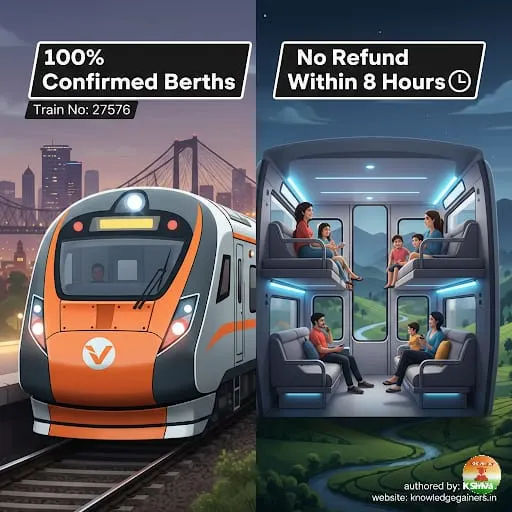
The most significant operational change accompanying the Vande Bharat Sleeper is the implementation of the Railway Passengers (Cancellation of Ticket and Refund of Fare) Amendment Rules, 2026. These rules, effective January 16, 2026, establish a rigorous protocol for refunds, departing sharply from the legacy rules governing other express trains. The driving logic behind these changes is the "100% confirmed berth" policy; because the train issues only confirmed tickets - with no provision for Reservation Against Cancellation (RAC) or waiting lists - last-minute cancellations lead to empty berths that cannot be filled by waitlisted passengers, resulting in direct revenue loss.
Comparison of Cancellation Rules (2026 Implementation)
Cancellation Timing | Vande Bharat Sleeper / Amrit Bharat II | Conventional Express/Rajdhani |
More than 72 Hours | 25% Deduction of Fare | Flat Fee (Rs 60–Rs 240 based on class) |
72 Hours to 8 Hours | 50% Deduction of Fare | 25% to 50% (between 48 and 4 hours) |
Less than 8 Hours | No Refund | 50% deduction (up to 4 hours) |
Chart Preparation Window | 8 Hours before departure | 4 Hours before departure |
TDR Filing Deadline | 8 Hours before departure | 4 Hours before departure |
The doubling of the chart preparation window from four to eight hours is the primary operational mechanism enabling these stricter rules. By preparing the chart earlier, the Railways aim to stabilize passenger lists and discourage speculative bookings on high-demand corridors. This policy reflects a transition toward a "Commitment Model" where the passenger's purchase of a premium ticket is viewed as a firm contract with limited room for late-stage modification.
Fiscal Strategy and Fare Dynamics
The fare structure for the Vande Bharat Sleeper is intentionally positioned as a premium product, situated between the Rajdhani Express and domestic air travel. A critical component of this strategy is the "Minimum Chargeable Distance," which is set at 400 km for Vande Bharat Sleeper trains and 200 km for Amrit Bharat II trains. This ensures the services remain focused on long-distance overnight travel rather than being utilized as expensive short-haul shuttles.
Comparative Fare Structure (Base Rates)
Distance / Route | AC 3-Tier (3A) | AC 2-Tier (2A) | AC First Class (1A) |
Per Km Rate | Rs 2.4 | Rs 3.1 | Rs 3.8 |
Min 400 km Fare | Rs 960 | Rs 1,240 | Rs 1,520 |
1,000 km Journey | Rs 2,400 | Rs 3,100 | Rs 3,800 |
Howrah-Kamakhya (Full) | Rs 2,435 | Rs 3,145 | Rs 3,855 |
Note: All fares are subject to additional GST and convenience fees.
The fares represent a premium of approximately 10–15% over the Rajdhani Express, which typically charges Rs 2.14 per km for 3AC and Rs 3.60 for 1AC. This higher pricing is justified by the Railways through faster transit times and superior amenities, such as high-quality mill-made linen, which includes a bed sheet, pillow cover, premium blanket, and hand towel.
Operational Deployment: The Howrah-Kamakhya Corridor
The selection of the Howrah-Kamakhya (Kolkata-Guwahati) route for the inaugural sleeper service was a strategic decision to enhance connectivity between Eastern India and the Northeast. This 960 km journey is completed in approximately 14 hours, a significant improvement over the 17–18 hours taken by legacy services like the Saraighat Express.
The service operates six days a week, avoiding Wednesday from Kamakhya and Thursday from Howrah for maintenance purposes. The train traverses 10 stops across seven districts in West Bengal and two in Assam, including Malda Town, New Jalpaiguri, and New Bongaigaon.
Route Logistics: Kamakhya to Howrah (Train No. 27576)
Segment Details | Specifications |
Departure (Kamakhya) | 6:15 PM (18:15 hrs) |
Arrival (Howrah) | 8:15 AM next day |
Total Distance | ~960–972 km |
Average Speed | 68 km/h (includes halts) |
Max Ops Speed | 130 km/h |
The impact of this service on regional trade and tourism is expected to be profound, particularly for businesses in Malda, the tea industry in North Bengal, and the petroleum sector in Bongaigaon. However, the inaugural commercial runs also revealed teething problems in logistics and catering that have sparked intense public debate.
Sociopolitical Discourse: The Catering and Cultural Controversy
The launch was marred by a significant controversy regarding the "veg-only" menu implemented on the Howrah-Kamakhya route. Despite connecting two regions (West Bengal and Assam) where fish and meat are central to the local diet, the Railways decided to serve only vegetarian meals.
Official spokespersons defended this decision by highlighting that the route connects two major pilgrim centers: the Maa Kamakhya Temple and the Maa Kali Temple. However, the Trinamool Congress (TMC) and local passengers criticized the move as "plate policing" and a cultural imposition. Political tensions were further exacerbated by reports of a "sharp drop" in food quality during regular commercial operations compared to the celebratory inaugural run.
Specific grievances included:
The "Spilled Dal" Incident: In one instance, passengers were told that dal was unavailable because the entire stock had spilled during the train's motion—an explanation that was met with skepticism given the train's advanced suspension system touted as its USP.
Service Lapses: Reports of dinner being served as late as 11:30 PM and the complete absence of morning tea service surfaced within the first week of commercial operations.
Catering Provider Disconnect: While the service was marketed as luxury catering by Mayfair Spring Valley Resort, passengers claimed the delivery from IRCTC base kitchens fell far short of these standards.
Maintenance, Passenger Behavior, and Civic Accountability
The physical maintenance of the world-class trainsets has emerged as a challenge related to passenger behavior. Within hours of the inaugural run, videos on social media showed coaches littered with food packets and waste, leading to a debate on "civic sense" in premium travel. The "passenger as a leveler" theory suggests that despite the premium fare (Rs 2,300 vs. Rs 1,500 for 3AC), behavior patterns remain consistent with standard trains, potentially undermining the premium positioning of the Vande Bharat brand.
Luggage rules for the sleeper version remain consistent with existing AC class provisions: 70 kg for First AC, 50 kg for Second AC, and 40 kg for Third AC. Compliance with these limits is being monitored more strictly to maintain the aesthetic and functional integrity of the coaches.
Strategic Forecast: Scaling the Fleet to 2047
Indian Railways has articulated a multi-phase vision for the Vande Bharat platform. By March 2027, the goal is to have 12 sleeper trainsets operational on major routes such as Delhi-Mumbai and Delhi-Howrah. This is part of a broader trajectory to reach 800 trainsets by 2030 and an ambitious 4,500 by 2047, aligned with the "Viksit Bharat" vision.
Planned Future Routes (2026–2027)
Priority Region | Specific Planned Routes |
Northern Corridors | Delhi to Ahmedabad, Bhopal, and Patna |
Southern Corridors | Thiruvananthapuram to Chennai, Bengaluru, and Mangaluru |
Central Corridors | New Delhi to Pune and Howrah |
Western Corridors | Mumbai to Ahmedabad (Dedicated high-speed corridor by 2027) |
The integration of the "Amrit Bharat II" series alongside the Vande Bharat Sleeper ensures that the modernization of rail travel is not restricted to the elite tier. All future Amrit Bharat trains (launched after January 2026) will adhere to the same 2026 refund rules and confirmed-berth policies, creating a unified standard of accountability across the premium and superfast segments.
Comparative Market Analysis: Vande Bharat Sleeper vs. Legacy Systems
The Vande Bharat Sleeper is strategically positioned to cannibalize both the top-tier rail market (Rajdhani) and the budget aviation market. While aviation offers speed, rail travel provides the advantage of city-center connectivity and the avoidance of airport logistics. The Vande Bharat Sleeper's "No RAC" policy is the final step in matching the airline model of guaranteed inventory.
However, the "Teething Problems" in catering and passenger civic sense represent the primary risks to this brand evolution. If the premium fare does not translate to a consistent, high-standard service—free from "spilled dal" excuses and littered coaches—the middle-class traveler may revert to the predictable, albeit slower, Rajdhani or the faster convenience of low-cost carriers.
Conclusion
The Vande Bharat Sleeper Express marks the dawn of a new era for Indian Railways, where technology, policy, and infrastructure are being synchronized to provide a semi-high-speed overnight experience. The 2026 cancellation and refund rules are the necessary, if unpopular, fiscal stabilizers for a system that can no longer afford the inefficiencies of last-minute cancellations in a confirmed-berth environment. As the network scales toward its 2047 targets, the focus must shift from engineering excellence to operational consistency, ensuring that the "Inaugural Shine" is not lost in the "Commercial Reality" of daily maintenance and service delivery. The success of this platform will ultimately depend on a three-way partnership between the engineering prowess of manufacturers like BEML, the administrative rigor of the Railway Ministry, and the civic responsibility of the Indian passenger.
Join our WhatsApp and Telegram Channels
Get Knowledge Gainers updates on our WhatsApp and Telegram Channels