Forest Rights or Paper Promises? The Hidden Struggle of Tribal Women in Srikakulam
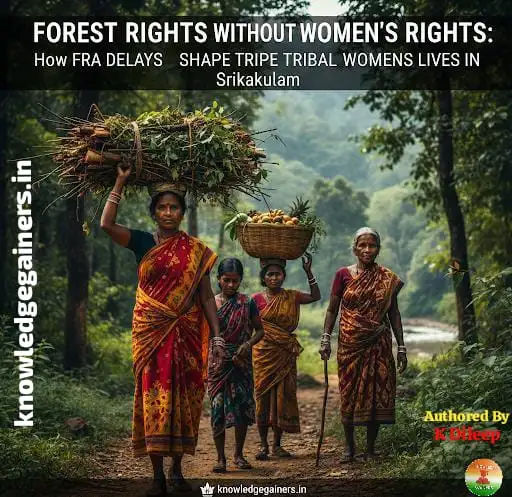
When we talk about "Forest Rights," we often think of maps, boundaries, and legal documents. But in the hilly terrains of Srikakulam, Andhra Pradesh, forest rights are a deeply personal—and gendered—struggle.
Despite the Forest Rights Act (FRA) of 2006 being nearly two decades old, a recent report highlights a jarring reality: tribal women are the backbone of the forest economy, yet they remain invisible in the eyes of the law.
The Invisible Laborers
In the Savara and Jatapu tribal communities, women spend their days navigating dense forests to collect minor produce like seasonal fruits, roots, and firewood. This isn't just a chore; it’s the primary lifeline for their families.
However, there is a massive gap between labor and power:
No Price Control: Even though women do the hard work of collection, the sale is often controlled by middlemen.
Economic Dependency: Many women admit they don't even know the final price their produce fetches, leaving them financially dependent on men or intermediaries.
Why the "Delay" is a Feminist Issue
The FRA was supposed to grant Community Forest Resource Rights (CFR). While some individual men have received land titles, community-wide rights remain stuck in administrative limbo.
This delay hits women hardest because:
Legal Literacy: Most tribal women are unaware that the law explicitly grants them rights over forest produce.
The Language Barrier: In Srikakulam, Gram Sabha (village council) meetings are often held in Telugu. For Savara women, who speak a language without a written script, this creates a wall of silence.
Individual vs. Collective: When the state focuses only on "individual" land titles, it ignores the collective forest areas where women actually work.
Beyond the Paperwork
The struggle in Srikakulam shows us that a law is only as good as its implementation. For the women of the Savara and Jatapu tribes, "rights" shouldn't just be a document locked in a government desk.
True progress requires accessible legal literacy, meetings held in local dialects, and the formal recognition of community lands. Until then, these women will continue to sustain the forest, while the law fails to sustain them.
Want to learn more? This overview is based on a deep-dive report by Feminism in India. To understand the full complexity of tribal displacement and the threat of industrial projects in the region.
Join our WhatsApp and Telegram Channels
Get Knowledge Gainers updates on our WhatsApp and Telegram Channels