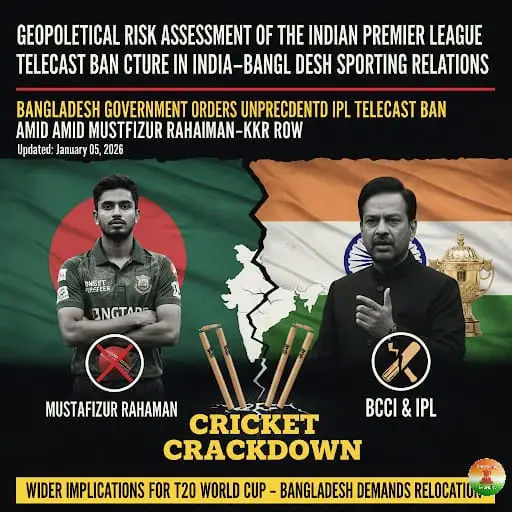
The decision by the interim government of Bangladesh to impose an indefinite and blanket ban on the telecast and promotion of the Indian Premier League (IPL) within its borders represents a seminal moment in the history of South Asian sports diplomacy. Issued on January 5, 2026, the directive from the Ministry of Information and Broadcasting signifies the formal collapse of "cricket diplomacy" between two nations whose bilateral ties were once characterized as a "Golden Chapter". This regulatory intervention, enacted ostensibly in response to the administrative exclusion of Bangladeshi pacer Mustafizur Rahman from the Kolkata Knight Riders (KKR) franchise, serves as a proxy for much deeper geopolitical anxieties, communal tensions, and institutional friction. The fallout has not only halted the commercial distribution of the world’s most lucrative cricket league in a primary market but has also imperiled the integrity of the upcoming ICC Men’s T20 World Cup, as the Bangladesh Cricket Board (BCB) has formally refused to travel to India for its group-stage fixtures.
The Mustafizur Rahman–KKR Contingency: A Forensic Analysis
The immediate catalyst for the current crisis was the forced termination of Mustafizur Rahman’s contract with the Kolkata Knight Riders. During the IPL 2026 mini-auction held in Abu Dhabi in December 2025, KKR acquired the 30-year-old left-arm seamer for a substantial valuation of ₹9.20 crore (approximately BDT 13 crore), following a competitive bidding sequence involving Chennai Super Kings and Delhi Capitals. Rahman’s acquisition was seen as a strategic move to bolster KKR’s death-over capabilities, given his proven track record of 65 wickets in 60 IPL appearances. However, the Board of Control for Cricket in India (BCCI) intervened on January 3, 2026, instructing the franchise to release the player with immediate effect.
The BCCI’s directive was articulated through Secretary Devajit Saikia, who cited "recent developments going on all across" as the rationale for the intervention. This phrasing is understood by regional analysts as a reference to the escalating reports of targeted violence against Hindu minorities in Bangladesh following the political transition in Dhaka. The administrative mechanism used by the BCCI to force this release highlights its dual role as a sporting regulator and a de facto arm of Indian state policy. By compelling a private franchise to annul a valid employment contract, the BCCI effectively prioritized national sentiment and domestic security concerns over commercial stability.
Mustafizur Rahman: IPL Career and Financial Valuation (2016–2026)
Metric | Details | |
Total IPL Wickets | 65 | |
Total IPL Matches | 60 | |
2026 Auction Price | ₹9.20 Crore (approx. $1.1M) | |
Base Price at Auction | ₹2 Crore | |
IPL Debut Season | 2016 (Sunrisers Hyderabad) | |
Previous Franchises | SRH, MI, RR, DC, CSK | |
Date of KKR Release | January 3, 2026 |
The release of Rahman triggered an immediate emotional response in Bangladesh. The interim government’s press release described the decision as lacking any "logical reason" and having "saddened, shocked and angered" the people of Bangladesh. This sentiment was echoed by Mustafizur himself, who, in a brief interaction with local media, expressed resignation, questioning what a player could do when dropped by administrative decree. The second-order effect of this release was the immediate transformation of a sporting dispute into a crisis of national dignity for the Bangladeshi state.
Domestic Political Pressure and the Communal Subtext in India
The BCCI's intervention did not occur in a vacuum but was the result of sustained pressure from diverse political and religious segments within India. Following KKR’s signing of Rahman, several leaders from the Bharatiya Janata Party (BJP) and Shiv Sena expressed public outrage. Sangeet Som, a former MLA from Uttar Pradesh, hailed the BCCI’s directive as a "victory of the Hindus of the entire nation" and thanked the board for recognizing the sentiments of "100 crore Sanatanis". Critics focused their vitriol on KKR co-owner and Bollywood superstar Shah Rukh Khan, with some politicians labeling him a "traitor" for hiring a Bangladeshi national while reports of atrocities against Hindus in Bangladesh were surfacing.
The backlash extended to religious leaders such as Devkinandan Thakur and Imam Umer Ahmed Ilyasi. Thakur questioned the heartlessness of team owners who would include players from a country where Hindus were reportedly being murdered and their homes burned. This public pressure forced a convergence between religious sentiment and sports policy, leading the BCCI to view Rahman’s participation not as a cricketing matter but as a potential flashpoint for civil unrest during IPL fixtures, particularly those scheduled in Kolkata, a city with deep historical and cultural ties to the Bangladesh region.
The Security Crisis in Bangladesh: A Timeline of Minority Targeted Violence
The root cause of the BCCI’s "preventive measure" lies in a deteriorating human rights and security landscape in Bangladesh that emerged in late 2025. Following the ouster of Sheikh Hasina in August 2024, the country experienced a systemic erosion of the rule of law, which culminated in a violent December 2025 timeline. A critical escalation was the assassination of Osman Hadi, a spokesperson for the Inqilab Moncho, who died on December 18, 2025, from gunshot wounds sustained a week earlier. His death triggered nationwide riots and mob attacks on cultural centers, diplomatic missions, and media houses, including the headquarters of Prothom Alo and The Daily Star, which were branded as "Indian agents".
Amidst this broader political upheaval, Hindu minorities faced a spate of targeted killings and arson. The Bangladesh Hindu Buddhist Christian Unity Council reported at least five deaths of Hindu individuals in December 2025 alone. These included the lynching of Dipu Chandra Das in Mymensingh on December 18 and the brutal attack on Khokon Chandra Das in Shariatpur on December 31, 2025. Khokon, a medicine shop owner, was intercepted while returning home, hacked with sharp weapons, doused in petrol, and set on fire; he succumbed to his injuries on January 3, 2026, the same day the BCCI issued its directive to KKR.
Documented Violence Targeting Minorities and Institutions (Dec 2025)
Date | Victim/Target | Location | Nature of Incident | S.No |
Dec 12, 2025 | Osman Hadi | Dhaka | Shooting by masked assailants | 1 |
Dec 18, 2025 | Dipu Chandra Das | Mymensingh | Mob lynching over blasphemy claims | 2 |
Dec 18, 2025 | Prothom Alo | Dhaka | Headquarters vandalized and set on fire | 3 |
Dec 23, 2025 | Hindu Homes | Raojan | Arson attack on expatriate workers' homes | 4 |
Dec 24, 2025 | Amrit Mondal | Rajbari | Beaten to death by a mob | 5 |
Dec 31, 2025 | Khokon Chandra Das | Shariatpur | Hacked and set on fire; died Jan 3 | 6 |
Jan 5, 2026 | Bajendra Biswas | Mymensingh | Shot dead at a garment factory | 7 |
Sociological analysis of these events suggests a phenomenon of "norm erosion," where the interim administration’s failure to enforce the rule of law has allowed "informal veto players" radical groups outside the government to influence state decisions through the threat of violence. The United Nations Secretary-General and the High Commissioner for Human Rights have both urged the Bangladeshi authorities to conduct thorough, impartial investigations, warning that retaliation and revenge will only deepen regional divisions.
Regulatory Retaliation: The IPL Telecast Ban in Bangladesh
In an immediate counter-measure to the BCCI’s actions, the Bangladesh Ministry of Information and Broadcasting ordered an indefinite ban on the telecast and promotion of the IPL on January 5, 2026. The official directive, signed by Assistant Secretary Firoz Khan, instructed all television channels and streaming platforms to cease the broadcast of matches and related events until further notice. This move was framed by government advisors as a necessary defense of national dignity. Asif Nazrul, the Advisor for Youth and Sports, declared on social media that "the days of servitude are over" and that Bangladesh would not tolerate insults to its cricketers or the country.
The mechanism of this ban is unprecedented; while Bangladesh has experienced political instability in the past, it had never before banned the telecast of a major international sporting event. The Information and Broadcasting Advisor, Syeda Rizwana Hasan, clarified that the government was reviewing the legal frameworks to ensure the ban’s procedural validity. She argued that while sports should ideally remain independent of politics, the "political grounds" cited for Mustafizur Rahman’s exclusion necessitated a firm response to reflect public sentiment.
Impact on the Media and Broadcasting Sector
The financial repercussions for Bangladeshi broadcasters, specifically T Sports and GTV, are substantial. These entities have broadcast the IPL since its inception in 2008 and rely heavily on the league for annual advertising revenue. The sudden suspension of these rights, occurring just months before the March 26 season start, creates a significant deficit in planned commercial income and risks secondary impacts on domestic sponsors who had integrated IPL associations into their 2026 marketing calendars.
The ICC T20 World Cup Stalemate: Scheduling and Logistical Risks
The dispute has escalated into a multilateral crisis involving the International Cricket Council (ICC). Bangladesh is scheduled to participate in the ICC Men’s T20 World Cup, co-hosted by India and Sri Lanka, from February 7 to March 8, 2026. Following the Mustafizur-KKR row, the BCB held two emergency meetings and resolved that the national team would not travel to India for its group-stage matches. The board has formally requested the ICC to relocate these matches to Sri Lanka, citing "growing concerns regarding the safety and security" of its contingent.
Under the original schedule, Bangladesh was drawn in Group C alongside England, Italy, Nepal, and the West Indies. Three of their matches were slated for Eden Gardens in Kolkata, with a final group match at the Wankhede Stadium in Mumbai. The BCB’s refusal to travel poses a logistical "nightmare" for the ICC, led by Chairman Jay Shah. Reworking the schedule just four weeks before the tournament involves renegotiating air travel, hotel accommodations, and broadcast logistics for multiple international teams.
Original Group C Schedule for Bangladesh (Prior to Boycott)
Date | Opposition | Venue | Local Time | S. No |
Feb 7, 2026 | West Indies | Eden Gardens, Kolkata | 3:00 PM | 1 |
Feb 9, 2026 | Italy | Eden Gardens, Kolkata | 11:00 AM | 2 |
Feb 14, 2026 | England | Eden Gardens, Kolkata | 3:00 PM | 3 |
Feb 17, 2026 | Nepal | Wankhede Stadium, Mumbai | 7:00 PM | 4 |
The ICC is reportedly working on a revised schedule, potentially adopting a "neutral venue" model for Bangladesh, similar to the one already in place for Pakistan. However, Indian cricketing legends like Harbhajan Singh have noted that while India is open to hosting all teams, the decision to participate ultimately rests with Bangladesh, suggesting a hardening of the Indian stance toward the relocation request.
The "Pakistan-ization" of India–Bangladesh Bilateral Cricket
The most significant long-term consequence of the Mustafizur Rahman row is the potential for a permanent halt in bilateral cricketing relations between India and Bangladesh. Historically, Bangladesh was viewed as an alternative to Pakistan a reliable regional partner with whom India could engage in regular bilateral series. However, the current diplomatic trajectory suggests a "Pakistan-style" wall is being erected.
The BCCI has already put on hold India’s scheduled tour of Bangladesh in September 2026, which was set to consist of three ODIs and three T20Is. This tour, which was originally postponed from August 2025 due to diplomatic standoffs, is now unlikely to receive the necessary Indian government clearances. If bilateral ties are frozen, the two nations may only face each other at neutral venues during global ICC or ACC events, a state of affairs that has defined India-Pakistan cricket for over a decade.
Legal and Economic Implications: Force Majeure and Market Value
The exclusion of Rahman also raises critical questions regarding the legal validity of IPL player contracts and the authority of the BCCI to override franchise decisions. Professional player contracts in the IPL typically include a "force majeure" clause, which frees parties from obligations in extraordinary circumstances such as war or civil unrest. While the BCCI used "recent developments" as a justification, the lack of a formal "force majeure" declaration for the 2026 season makes the release of a contracted player for political reasons a potential legal grey area.
From an economic perspective, the loss of Bangladeshi players primarily Mustafizur Rahman and Shakib Al Hasan-reduces the IPL’s footprint in a major cricket-consuming market. While Rahman's auction price was ₹9.20 crore, the broader loss of broadcast reach and sponsorship engagement from the Bangladeshi diaspora and domestic market could result in a significant cumulative impact on the league's valuation. Furthermore, the BCCI’s new rule, which bans players for two seasons if they withdraw post-auction without a valid reason, is complicated by this situation, as the withdrawal was mandated by the board itself rather than the player.
Future Outlook and Strategic Conclusions
The fracture in India–Bangladesh sporting relations is a direct reflection of a deeper geopolitical realignment in South Asia. The ouster of the India-friendly Awami League government has removed the strategic buffer that once protected cultural and sporting ties from communal volatility. As Bangladesh prepares for its February 2026 elections, the interim government’s adoption of a confrontational "anti-India" sporting policy serves as a tool for domestic political consolidation.
For the ICC, the challenge is to prevent the "Sri Lanka model" (where teams refuse to play in India/Pakistan) from becoming the default for South Asian tournaments, as this would undermine the logistical and commercial viability of hosting global events in the region. The immediate future suggests a period of "cold storage" for bilateral ties, with no resumption of tours until a stable, recognized government is established in Dhaka and security guarantees for minorities are verified by New Delhi. The IPL telecast ban is merely the most visible symptom of a relationship that has transitioned from cooperation to reactive containment.
In conclusion, the Mustafizur Rahman controversy has served as a catalyst for a systemic breakdown in institutional trust. The convergence of mob violence in Bangladesh, political pressure in India, and the subsequent regulatory retaliation has created a situation where cricket is no longer a bridge between the two nations but a primary theater of conflict. The outcome of the ICC’s scheduling deliberations in the coming weeks will determine whether this fracture remains a bilateral dispute or evolves into a broader crisis for international cricket governance.
Extended Analysis: Institutional and Cultural Divergence
The collapse of the India–Bangladesh cricketing relationship can be further understood through the lens of institutional divergence. On the Indian side, the BCCI has increasingly moved toward a model of "Nationalist Cricket Governance," where the league's commercial interests are secondary to the state’s diplomatic and security narrative. This is evident in the board's willingness to absorb the potential legal and financial blowback from terminating a high-value contract like Rahman's to satisfy a domestic political consensus. Conversely, the BCB is currently operating under a "Reactive Nationalist" framework, where decisions are driven by the need to demonstrate sovereignty and resistance to Indian influence in the wake of the 2024 revolution.
The Role of "Informal Veto Players" in Bangladesh
The concept of "informal veto players" is central to understanding why the interim government acted so aggressively in banning the IPL. Groups such as the Inqilab Moncho and radical student factions have demonstrated the ability to paralyze the state through mob violence, as seen in the attacks on Prothom Alo and the killing of Osman Hadi. For the interim government, allowing the IPL: a symbol of Indian soft power and cultural dominance to be broadcast while a national hero like Mustafizur was being "humiliated" would have provided these groups with a potent narrative for further unrest. The telecast ban was thus a preemptive strike to maintain domestic order as much as it was a retaliatory diplomatic gesture.
Comparative Timeline of Regional Diplomacy and Sporting Incidents (2024–2026)
Year | Month | Event | Geopolitical Context | S.No |
2024 | August | Ouster of Sheikh Hasina | Shift from India-friendly to Interim Government | 1 |
2024 | October | Protests over land grabbing | 21 Hindu families protest in Patukhali | 2 |
2025 | May | IPL 2025 suspension | Resumption amid India-Pakistan border tensions | 3 |
2025 | August | September Tour Postponed | Bilateral series deferred to Sept 2026 | 4 |
2025 | December | "Christmas Violence" | Communal incidents reported across India | 5 |
2025 | December | Murder of Dipu Chandra Das | Mymensingh lynching triggers regional protests | 6 |
2026 | January | Mustafizur Release | BCCI orders KKR to terminate Rahman's contract | 7 |
2026 | January | IPL Telecast Ban | Bangladesh government halts all IPL broadcasts | 8 |
The Logistical Nightmare: ICC's Dilemma and the Sri Lanka Variable
The ICC’s decision-making process is complicated by the presence of Italy and Nepal in Bangladesh's World Cup group. Unlike high-profile teams with massive logistical support, smaller associates may face greater difficulties with sudden venue shifts regarding visas and training facilities. Furthermore, the "Sri Lanka model" of hosting matches creates a broadcast nightmare, as crews and equipment must be moved between two island nations with limited lead time. Jay Shah’s leadership is under intense scrutiny; as the former head of the BCCI, his ability to force Bangladesh to travel to India is limited by the genuine security concerns cited by the BCB, making a compromise the only viable path forward for the 2026 T20 World Cup.
Economic Forensics: Broadcast Rights and Future Valuations
The long-term economic impact of the ban centers on the next cycle of IPL broadcast rights in the Indian subcontinent. While India remains the primary revenue driver, the exclusionary precedent set by this ban may lead future bidders for the Bangladeshi territory (such as Togi Sports/Bashundhara Group) to seek lower valuations or "political risk" discounts in their contracts. For the BCCI, the trade-off between "National Sentiment" and "Global Commercial Expansion" has never been more stark. The release of Mustafizur Rahman, though a single player, signals to all international stars that their contracts are subject to the prevailing winds of regional politics, potentially cooling the interest of overseas players in future "mini-auctions".
Conclusion of Strategic Assessment
The fracture in Indo-Bangla relations is no longer a temporary diplomatic spat but a structural shift. The "unprecedented" nature of the IPL telecast ban and the World Cup boycott suggests that cricket in South Asia has entered an era of "Splintered Commercialism," where nationalistic ideologies take precedence over the unified growth of the sport. The regional stability of the subcontinent, once bolstered by the shared language of cricket, is now further compromised as the sport becomes a primary tool of state-level retaliation and communal signaling.
Join our WhatsApp and Telegram Channels
Get Knowledge Gainers updates on our WhatsApp and Telegram Channels