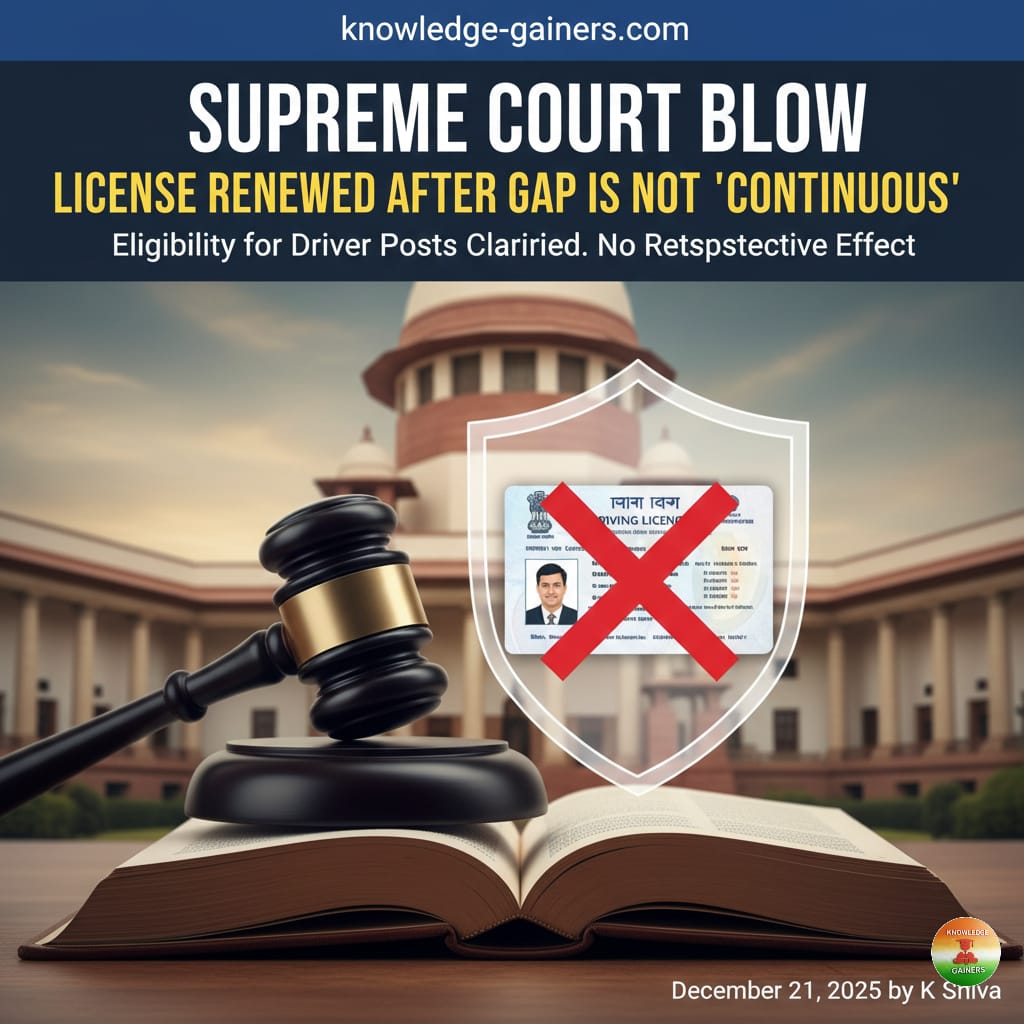
In a landmark judgment that carries significant weight for both job seekers and everyday drivers, the Supreme Court of India has clarified the legal status of renewed driving licences. The Court ruled that if a driving licence is renewed after a gap following its expiry, the renewal will not operate retrospectively from the date of expiry.
This decision emphasizes that driving is a skill requiring "hands-on experience and regular practice," and a break in the validity of a licence constitutes a break in the legal qualification to drive.
The Core of the Dispute: Telangana Police Recruitment
The ruling surfaced from a challenge against the Telangana State Level Police Recruitment Board. The Board had set specific eligibility criteria for driver posts, requiring candidates to have held a valid driving licence "continuously" for a prescribed number of years.
Several candidates had licences that had expired. Although they renewed them within the one-year grace period allowed under the Motor Vehicles Act, there was a "gap" between the expiry date and the renewal date. The candidates argued that since the law allows renewal within a year, the licence should be treated as valid throughout that period.
The Supreme Court disagreed.
The Supreme Court's Key Findings
1. Driving is an Active Skill, Not Just Paperwork
The Bench noted that driving is not merely a static qualification. The Court observed:
"Driving is not merely a qualification on paper but also involves hands-on experience coupled with regular practice."
By allowing a licence to lapse, the legal presumption of that "regular practice" is interrupted.
2. The "Gap" Matters
The Court clarified that the Section 15 of the Motor Vehicles Act provides a grace period for renewal, but it does not mean the licence is "deemed to be valid" during the days or months it remained expired. If a licence expires on January 1st and is renewed on March 1st, the individual did not legally hold a licence for those two months.
3. Interpretation of "Continuously"
For recruitment purposes, the term "continuously" must be interpreted literally. A candidate must show an unbroken chain of validity. Even if the law allows a late renewal, that renewal acts as a "fresh breath of life" from the date of the renewal application/issue, not a retroactive cure for the expired period.
Implications for Drivers and Job Aspirants
This ruling creates a strict standard for anyone applying for government roles (Police, Fire Services, Transport Corporations) where a driving licence is a mandatory requirement.
Scenario | Legal Status | Eligibility Impact |
Renewal BEFORE Expiry | Continuous | Fully Eligible |
Renewal within Grace Period | Valid for driving (post-renewal) | Ineligible for "Continuous" requirements |
Renewal after 1 Year | Requires Re-test | Ineligible for "Continuous" requirements |
Critical Takeaways from the Judgment
No Retrospective Effect: A late renewal does not "backdate" the validity to the day the old licence expired.
Recruitment Standards: Recruitment boards have the right to strictly interpret "continuous" holding of a licence to ensure they hire practiced and legally compliant drivers.
Safety and Practice: The court linked legal validity to road safety, suggesting that a person who lets their licence lapse might not be maintaining the rigorous standards required for professional driving.
What Should You Do?
Check Your Expiry: Always initiate the renewal process 30 to 60 days before your current licence expires.
Avoid the Grace Period Trap: Do not rely on the one-year grace period if you intend to apply for professional driving jobs; a single day's gap can disqualify you from future government service.
Digital Records: Keep a track of your renewal dates on the mParivahan app to ensure you never miss a deadline.
Final Takeaway
The Supreme Court has sent a clear message: The law rewards the vigilant. A driving licence is a privilege that requires active maintenance. For those in the middle of recruitment processes, this judgment serves as a stern reminder that "technical renewals" cannot overwrite factual gaps in eligibility.
Join our WhatsApp and Telegram Channels
Get Knowledge Gainers updates on our WhatsApp and Telegram Channels