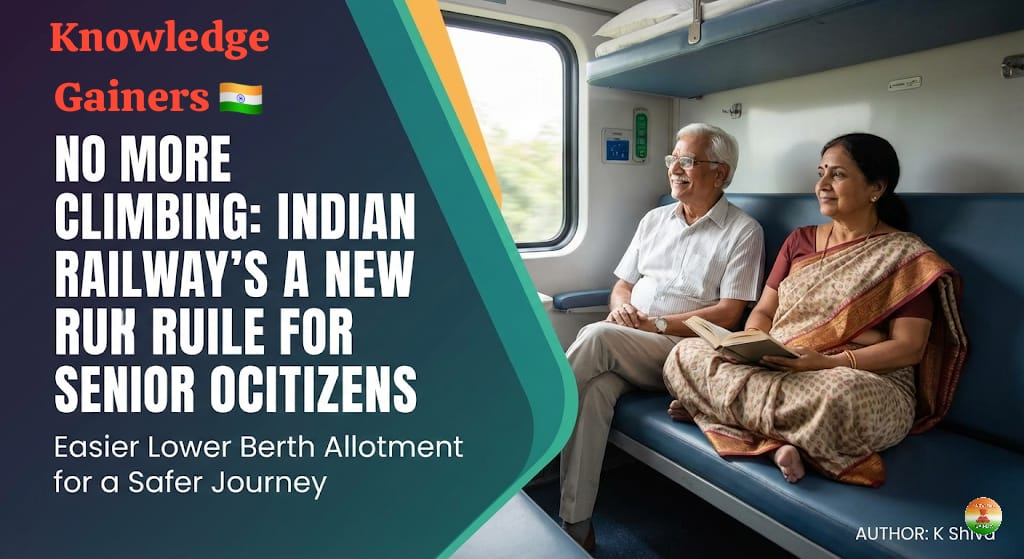
For millions of elderly passengers in India, train journeys often come with a lingering anxiety: "Will I get a lower berth, or will I be forced to climb to the top?"
Addressing this long-standing concern, Indian Railways has introduced a significant rule change aimed at prioritizing travel comfort for senior citizens. The updated guidelines are designed to make the allocation of lower berths smoother, reducing the physical strain and safety risks associated with upper berths.
Here is a detailed look at what this new rule means for elderly travelers and their families.
Why This Change Was Long Overdue
For younger passengers, climbing to an upper or middle berth is a minor inconvenience. But for senior citizens, it can be a daunting physical challenge. Issues like arthritis, weak knees, and general mobility constraints make climbing ladders risky and painful.
In the past, many seniors found themselves allotted upper berths despite their age, leading to frantic requests to fellow passengers for seat exchanges. Acknowledging these frequent complaints and the genuine need for a more considerate system, Indian Railways has revised its berth allotment logic to prioritize safety and ease.
How the New System Works
The core of this update is an automatic priority logic embedded in the booking system.
Age-Based Recognition: When a passenger enters their age during the ticket booking process, the system automatically tags them as a senior citizen.
Automatic Prioritization: Unlike the previous system where lower berths were often a matter of luck, the new algorithm is programmed to hunt for available lower berths specifically for these tagged profiles.
No Special Requests Needed: You do not need to fill out complex forms or make special requests. If a lower berth is available at the time of booking, the system will try to assign it to the senior passenger by default.
Who Stands to Benefit?
This move is a massive relief for:
Elderly Passengers: Especially those travelling alone who cannot rely on family members to swap seats.
Passengers with Mobility Issues: The rule implicitly aids those who find physical movement difficult.
Families: Travelling with grandparents becomes less stressful when you know the system is actively trying to seat them safely.
Does It Apply to All Classes?
Yes, the rule is inclusive. The priority system applies across multiple train classes where berth configurations exist, including:
Sleeper Class (SL)
AC 3 Tier (3A)
AC 2 Tier (2A)
This ensures that whether a passenger is travelling on a budget or in luxury, the "comfort first" policy remains consistent.
What If All Lower Berths Are Full?
It is important to note that while the system prioritizes seniors, it cannot create seats that don't exist. If all lower berths are already booked by other seniors or eligible passengers:
Availability Basis: Allotment will revert to remaining available seats.
On-Board Assistance: Indian Railways has instructed on-board staff (TTEs) to be more proactive. If a senior is stuck with an upper berth, staff are encouraged to help facilitate seat adjustments with other willing passengers where possible.
A Step Toward Inclusive Travel
This rule is part of a broader push by Indian Railways to make public transport more senior-friendly. It complements existing measures such as:
Senior Citizen Quotas: Specific seats reserved only for the elderly.
Station Assistance: Wheelchair availability and Sahayak services.
Priority Seating: Designated spots in waiting halls.
Conclusion
This update is more than just a technical tweak in a software algorithm; it is a move toward dignity and safety. By removing the struggle of climbing berths, Indian Railways is ensuring that the golden years of its passengers are respected.
For senior citizens and their families, the next train journey promises to be just a little bit more relaxing.
Join our WhatsApp and Telegram Channels
Get Knowledge Gainers updates on our WhatsApp and Telegram Channels