
Traveling by train in India is set to become slightly more expensive for long-distance commuters. The Ministry of Railways has announced a marginal increase in passenger fares, effective from December 26. While the hike aims to bolster railway infrastructure and safety, the government has ensured that short-distance travelers and daily commuters remain unaffected.
Here is a detailed breakdown of the new fare structure and why these changes are being implemented.
Key Highlights of the 2025 Fare Revision
The new fare rates focus specifically on journeys exceeding 215 kilometers. The increase is categorized based on the class of travel:
Unreserved Category: For journeys beyond 215 km, fares have increased by 1 paisa per kilometer.
Reserved Category (AC and Non-AC): For journeys beyond 215 km, passengers will now pay an additional 2 paise per kilometer.
No Change for Short Distances: There is absolutely no change in fares for journeys up to 215 km.
No Impact on Suburban Travel: Commuters in major cities like Mumbai, Delhi, Kolkata, and Chennai using local trains will face no additional burden.
Monthly Season Tickets (MST): Holders of monthly season tickets are exempt from this hike.
Impact on the Passenger's Pocket
The Ministry has emphasized that the impact on individual passengers will be minimal. To put this into perspective, for a 500 km journey in a non-AC class, the ticket price will increase by only ₹10.
Important Note for Advance Bookings: If you have already booked your tickets before the announcement, the new rates will not apply to you. The hike only affects tickets purchased on or after December 26.
Why is the Fare Increasing?
This is the second fare hike in six months, following a similar marginal increase on July 1st. The Railways provided several reasons for this necessary adjustment:
Network Expansion: Over the last decade, there has been a massive expansion in the rail network and the number of trains operating across the country.
Safety and Efficiency: Significant investments are being made to strengthen railway safety and operational efficiency.
Rising Operational Costs: The total operating cost for the Railways for the year 2024-25 is estimated at ₹2.63 lakh crore.
Increased Workforce Expenses: To ensure better safety, the number of railway personnel has been increased. Consequently, the expenditure on salaries and allowances has reached ₹1.15 lakh crore, while pension costs have hit nearly ₹60,000 crore.
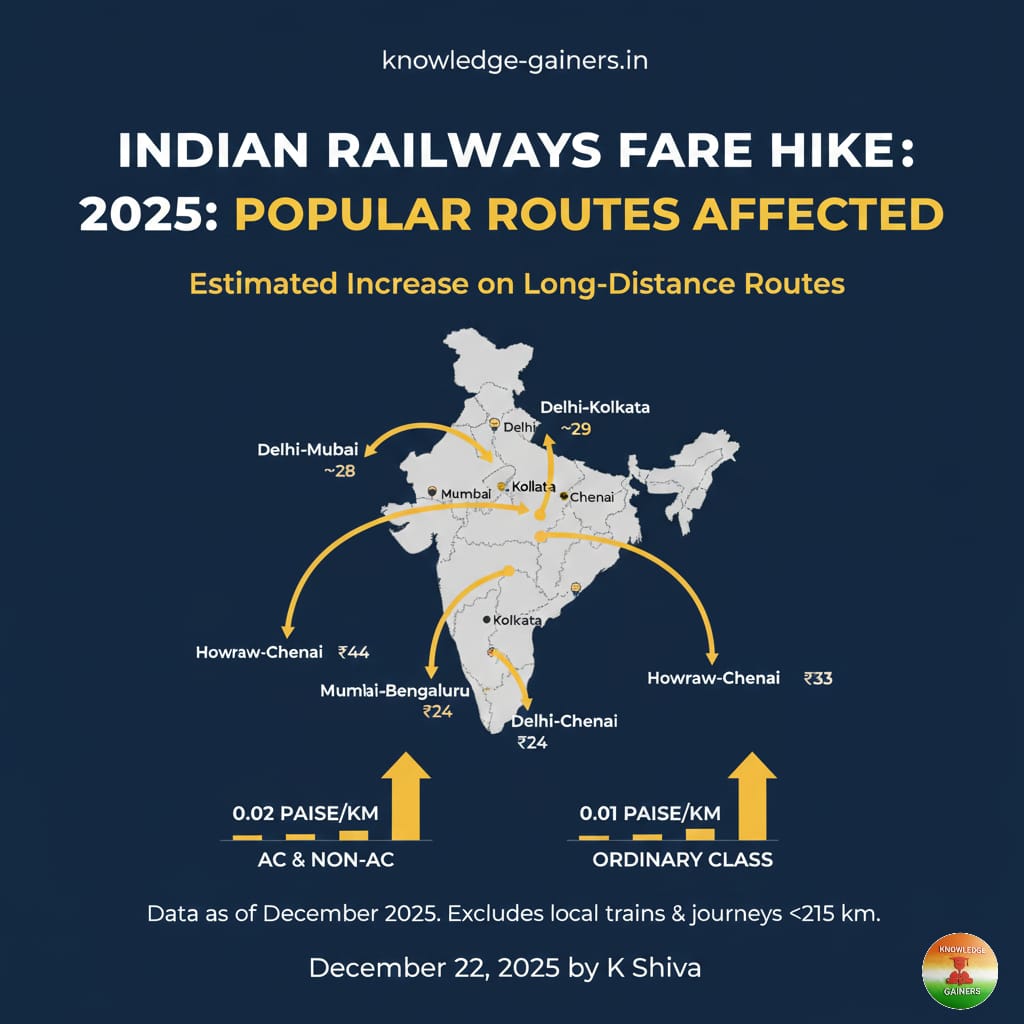
Estimated Fare Increase on Popular Routes (2025)
Route | Approx. Distance (km) | Category | Hike Rate (per km) | Est. Total Base Fare Increase |
Delhi – Mumbai | ~1,400 km | Mail / Express (AC & Non-AC) | ₹0.02 | ~₹28 |
Delhi – Kolkata | ~1,440 km | Mail / Express (AC & Non-AC) | ₹0.02 | ~₹29 |
Delhi – Chennai | ~2,200 km | Mail / Express (AC & Non-AC) | ₹0.02 | ~₹44 |
Howrah – Chennai | ~1,660 km | Mail / Express (AC & Non-AC) | ₹0.02 | ~₹33 |
Mumbai – Bengaluru | ~1,200 km | Mail / Express (AC & Non-AC) | ₹0.02 | ~₹24 |
Any Long Route | 500 km | Non-AC (Sleeper/2S) | ₹0.02 | ₹10 |
Important Details to Remember:
Exemptions: These hikes do not apply to suburban local trains, Monthly Season Tickets (MST), or any ordinary class travel under 215 km.
Ordinary Class (Long Distance): For journeys beyond 215 km in the Ordinary/General class, the increase is lower, at 1 paisa per km.
Ancillary Charges: Reservation fees, superfast surcharges, and GST remain unchanged; the hike applies only to the base fare.
Existing Tickets: If your ticket was booked before December 26, you will not be required to pay the difference.
Financial Outlook
The Railways estimates that this marginal hike will generate an additional ₹600 crore in annual revenue. This extra income is vital for maintaining Indian Railways' position as the world's second-largest freight rail system and continuing its modernization journey.
Final Takeaway
While any hike in travel costs is noteworthy, the Indian Railways has structured this increase to be as gentle as possible. By exempting local commuters and short-distance travelers, the primary goal remains supporting the massive infrastructure and safety upgrades required for a growing nation.
Join our WhatsApp and Telegram Channels
Get Knowledge Gainers updates on our WhatsApp and Telegram Channels