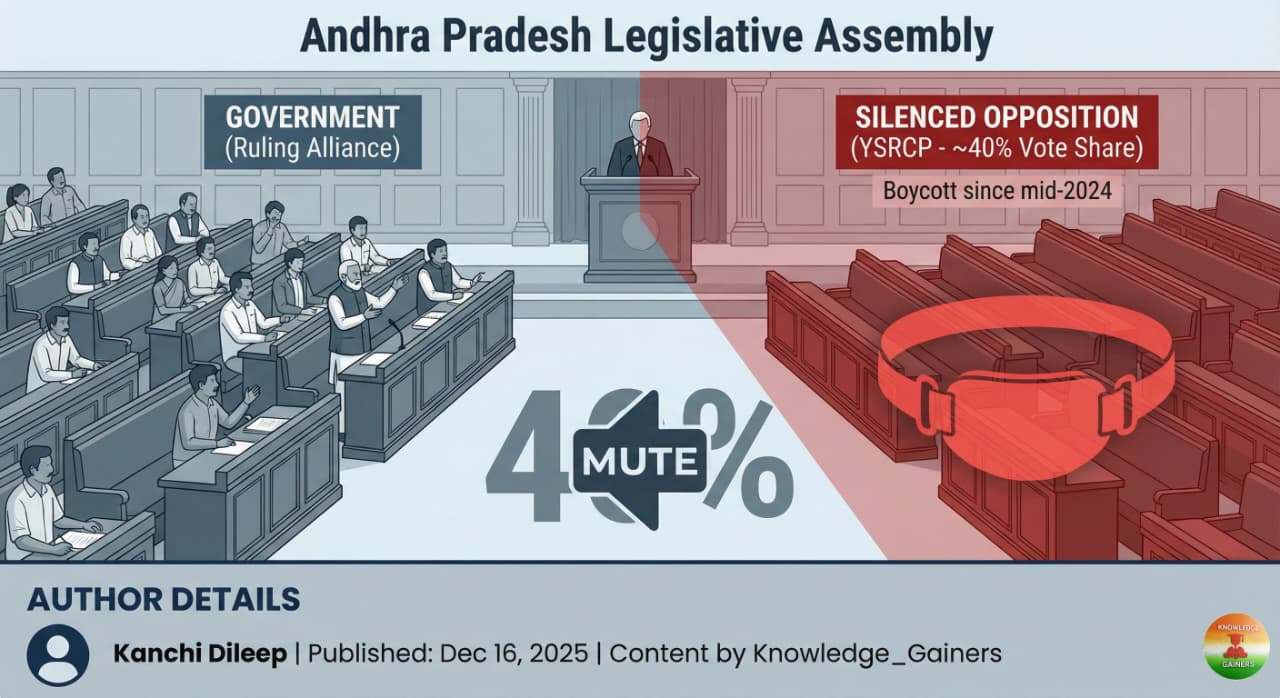
Democracy is often a numbers game, but in Andhra Pradesh, the numbers aren't adding up.
Imagine a scenario where nearly 40% of the electorate voted for a party, yet their voice has completely vanished from the state legislature. This isn't a case of suppressed votes or election malpractice—it is a deliberate political silence.
The Curious Case of the Missing Opposition
In the 2024 Assembly elections, the YSRCP secured a massive 39.37% vote share. By all metrics, this should guarantee a thunderous opposition bench capable of debating, questioning, and holding the ruling government accountable.
Instead, the Assembly has fallen silent.
During the recent Monsoon Session, 22 bills were passed with virtually zero opposition participation. Why? Because the YSRCP has chosen a strategy of "total withdrawal." protesting the Speaker's refusal to grant them official Opposition status.
Why This Matters
This situation goes beyond political ego battles. It raises a critical question about the health of our legislative institutions:
The Difference between "Can't" and "Won't": Unlike states where opposition parties are numerically too small to fight, Andhra’s opposition has the numbers but refuses to engage.
Governance without Brakes: Laws are being enacted swiftly, but without the necessary friction of debate or amendment.
The Precedent: Is this the new normal? Are parties evolving from legislative actors into pure electoral machines that only function when they are in power?
The Deep Dive
How does a strategy of "boycott" hurt the very voters it claims to protect? And what happens to a democracy when the opposition benches are empty by choice, not by chance?
We’ve broken down the constitutional, political, and democratic costs of this standoff in our latest study.
[Read the full analysis here to understand the future of Andhra's democracy]
Join our WhatsApp and Telegram Channels
Get Knowledge Gainers updates on our WhatsApp and Telegram Channels